
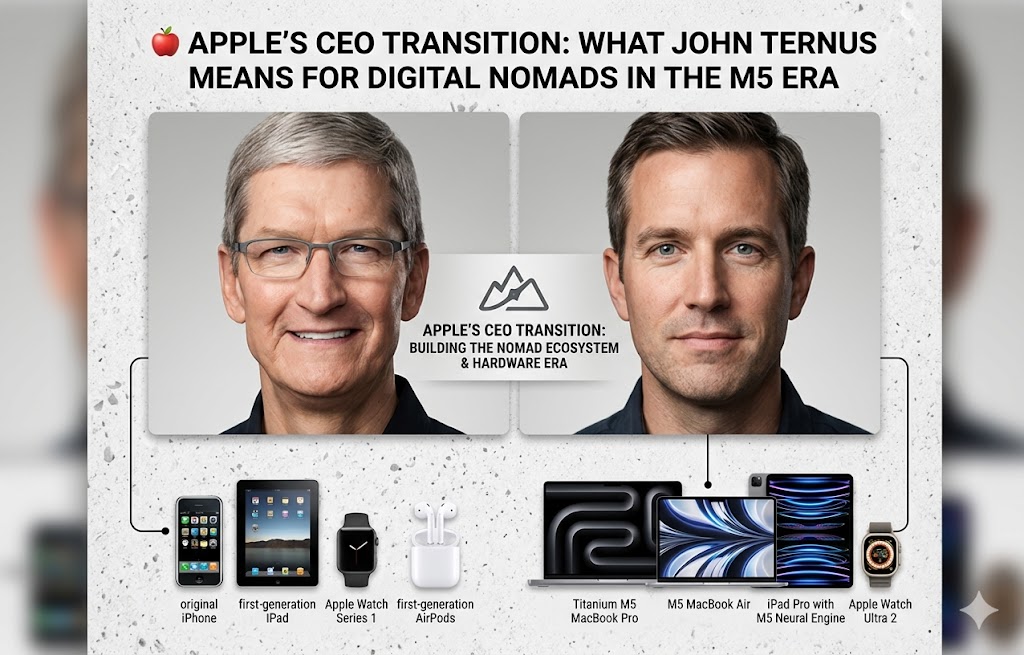
When Apple officially announced yesterday that Tim Cook will step down as CEO on September 1, 2026, handing the reins to hardware engineering chief John Ternus, the tech world immediately began speculating about stock prices and market share. But for digital nomads, remote workers, and one-bag travelers, the question is much more practical: What does this mean for the gear in our backpacks right now?
If your entire livelihood fits into a 30-liter travel backpack, every single gram, millimeter, and watt of your tech setup matters. Over the last 15 years, Tim Cook transformed Apple from a computer company into a ubiquitous mobile ecosystem, practically inventing the modern remote work lifestyle. Now, with a veteran hardware engineer taking the helm just as the groundbreaking M5 Apple Silicon reaches maturity, we are entering an unprecedented era of ultralight, hyper-efficient travel tech.
Here is our master guide on how this leadership shift will impact your global workflow, the material science behind the M5 generation of gear, and the absolute best Apple hardware you can buy right now to future-proof your digital nomad setup for the next half-decade.
🧭 Quick Comparison: The M5 Digital Nomad Setup 2026
Before we dive into the thermodynamics and hardware philosophy of the upcoming Ternus era, let’s look at the current state of Apple’s best mobile workstations. When building a budget vs premium travel setup, your primary computing hub is the most critical decision you will make.
| Category | 💰 Budget Pick | 🥇 Premium Pick | Key Tech Spec |
| Primary Workstation | Apple MacBook Air 13-inch (M5) | Apple MacBook Pro 14-inch (M5 Pro) | 2nm Apple Silicon Efficiency |
| Weight Profile | 1.18 kg (2.6 lbs) | 1.55 kg (3.4 lbs) | Crucial for 7kg Carry-on Limits |
| Nomad Capability | Fanless / Ultra-Silent / Cloud Work | Active Cooling / Local AI Rendering | Sustained Peak Workloads |
🏗️ 1. The Legacy of Tim Cook: Building the Nomad Ecosystem
To understand where Apple is going under John Ternus, we have to recognize the foundation Tim Cook built for the remote workforce. Under Cook’s tenure, Apple didn’t just release products; they built the invisible connective tissue that allows us to work from a beachside cafe in Bali or a high-speed train in Japan without skipping a beat.
The Wireless Revolution
Cook’s Apple ruthlessly eliminated physical dependencies. The controversial removal of the headphone jack paved the way for AirPods, which quickly became the standard-issue uniform for remote workers taking Zoom calls in noisy environments. The introduction of the Apple Watch allowed travelers to navigate foreign transit systems via subtle haptic feedback on their wrists, eliminating the need to flash a thousand-dollar iPhone on crowded, pickpocket-heavy streets.
The Origin of Apple Silicon
Perhaps Cook’s crowning achievement for travelers was the transition away from Intel to Apple’s proprietary M-series Silicon. Previously, powerful laptops were massive, heat-generating bricks that required heavy 140W power adapters and offered barely four hours of battery life. Apple Silicon fundamentally changed the laws of physics for digital nomads, culminating in today’s M5 architecture that offers desktop-class rendering power in laptops capable of surviving a 16-hour long-haul flight on a single charge.
⚙️ 2. Enter John Ternus: The Hardware and Material Science Era
John Ternus is not a supply-chain guru like Cook; he is a pure, unadulterated hardware engineer. Having overseen the development of the iPhone, iPad, and the entire Apple Silicon Mac transition, his ascension to CEO signals a massive shift toward aggressive hardware innovation, extreme durability, and advanced material science. These are the three factors most critical to the travel tech community.
Grade 5 Titanium and the Strict 7kg Carry-On Limit
One-bag travelers live and die by the strict 7kg (15.4 lbs) cabin baggage limits enforced by budget airlines in Europe and Asia. Every ounce shed is a hard-won victory. Under Ternus, we have seen Apple deeply embrace Grade 5 Titanium across its Pro product lines.
Titanium possesses one of the highest strength-to-weight ratios of any metallic element on the periodic table. It is significantly lighter than the aerospace-grade aluminum Apple relied on for over a decade, yet vastly more resistant to the dents, micro-abrasions, and structural bending that inevitably occur during rigorous travel. By utilizing Titanium chassis designs in the M5 era, Ternus is allowing digital nomads to pack significantly more processing capability into lighter, more durable bags.
Thermodynamics, 2nm Fabrication, and Tropical Climates
If you have ever tried to compile complex code or render a 4K video on a hot afternoon in a non-air-conditioned cafe in Thailand, you are intimately familiar with thermal throttling. When a laptop logic board gets too hot, the system artificially suppresses its processor speeds to prevent melting its own internal components.
The new M5 chips utilize an astonishingly dense 2-nanometer (2nm) fabrication process. This means the transistors are packed closer together than ever before, resulting in electricity traveling shorter distances. The result? Massively reduced heat generation. Combined with Ternus’s engineering push for innovative new heat-pipe structures and conductive internal chassis designs, the M5 generation pulls heat away from the core flawlessly. This means your gear will sustain peak performance infinitely longer, regardless of the brutal ambient temperature of your exotic remote office.
🏆 3. Tiered Recommendations: Future-Proofing Your M5 Workflow
If you are packing your bags today, you need gear that bridges the gap between Cook’s seamless ecosystem and Ternus’s powerful hardware vision. Here are the absolute best M5 Apple workstations currently available on Amazon Canada for remote workers, categorized strictly by budget and workflow demands.
The Heavy-Duty Creator Hub
If your remote work involves compiling heavy software builds, editing high-bitrate ProRes video, or running intensive local 3D modeling environments, you cannot compromise on active cooling and comprehensive port selection.
🥇 Premium Choice: The Professional Nomad’s Workhorse
Product:Apple MacBook Pro 14-inch (M5 Pro)
Verdict: The undisputed king of mobile productivity in 2026. The M5 Pro chip handles massive local workloads effortlessly, while the built-in SDXC card reader and HDMI 2.1 port mean you don’t have to carry extra, easily-lost dongles in your tech pouch. While slightly heavier than the Air, its active cooling fan and Titanium-reinforced frame ensure you will never suffer thermal throttling in hot climates.
The Ultralight Minimalist
For writers, digital marketers, front-end developers, and consultants who live entirely in cloud-based applications or browsers, a Pro machine is unnecessary dead weight. You need a device that practically disappears in your daypack.
💰 Budget Choice: The Fanless Wonder
Product:Apple MacBook Air 13-inch (M5)
Verdict: This is arguably the greatest, most perfectly balanced travel laptop ever engineered. Weighing in at an absurdly light 2.6 lbs, it easily slides into the tightest backpack laptop sleeves. Because the 2nm M5 chip is so efficient, it lacks a cooling fan entirely. This makes it completely silent and permanently sealed against the destructive dust and sand of beachside workspaces.
🧠 4. The Tech-Forward Integration: On-Device AI for Off-Grid Nomads
The biggest challenge facing John Ternus as he steps into the CEO role is the full hardware integration of Artificial Intelligence. For digital nomads, AI has traditionally been a double-edged sword. Most powerful generative AI tools require a constant, high-bandwidth internet connection to communicate with massive, distant server farms. But what happens when your Airbnb Wi-Fi completely drops, or you are working from a remote mountain cabin with zero cellular service?
The Unrivaled Power of the M5 Neural Engine
This is where Ternus’s hardware focus becomes a massive, tangible advantage for travelers. The M5 Apple Silicon chips feature a vastly expanded, dedicated Neural Engine—a section of the processor built from the ground up specifically to run heavy machine learning models locally.
As Ternus leads Apple deeper into the AI era, we are seeing a massive paradigm shift toward on-device processing. This means real-time, zero-latency language translation, advanced algorithmic audio isolation for noisy Zoom calls, and complex automated generative text scripts run directly on your MacBook’s hardware, completely bypassing the need for an internet connection. For digital nomads traversing connectivity dead zones and relying on spotty café Wi-Fi networks, this offline AI capability isn’t just a luxury feature; it is absolute professional survival.
🛡️ 5. Protecting the Investment: Travel Maintenance & Power Delivery
Whether you choose the Premium M5 MacBook Pro or the Budget M5 MacBook Air, investing in top-tier Apple hardware requires a strict commitment to protecting it on the road. A spilled coffee on a tray table or a sudden power grid failure in a hostel can instantly end your remote work journey.
Mastering Global Power Flow
Never plug a premium M5 MacBook directly into an untested, ungrounded wall outlet in a developing country. Sudden voltage spikes are common and will instantly fry your logic board.
- Always route your power through a high-quality, auto-resetting GaN-powered universal adapter equipped with overload fuses.
- Because the M5 chips are so incredibly efficient, you no longer need to carry Apple’s massive charging bricks. A single 65W or 100W GaN travel block is more than enough to fast-charge your MacBook, your iPhone, and your AirPods simultaneously.
Physical Protection Strategies
Avoid cheap, hard-shell plastic cases that snap directly onto your MacBook. During transit, these cases actually trap microscopic, abrasive dust against the chassis, causing severe micro-scratches over time. Furthermore, they add entirely unnecessary bulk and weight to your carefully calculated carry-on limit. Instead, utilize a deeply padded, water-resistant laptop sleeve suspended tightly inside the false bottom of your main travel backpack to protect against blunt-force drops.
🏆 The “Final Five” Action Table: The Ultimate M5 Nomad Checklist
To build a seamless, Ternus-era remote work setup, you need more than just the laptop. Here is the final roundup of the Apple ecosystem essentials that every modern nomad should carry in 2026, all verified as currently available for immediate upgrade on Amazon Canada.
| Priority | Item | Role | Amazon Link |
| 1 | Apple MacBook Pro 14″ (M5 Pro) | Premium Primary Workstation | Check Price |
| 2 | Apple MacBook Air 13″ (M5) | Budget Ultralight Workstation | Check Price |
| 3 | Apple AirPods Pro (3rd Gen) | Crucial Noise-Cancellation | Check Price |
| 4 | Apple Watch Ultra 3 | Rugged Off-Grid Navigation | Check Price |
| 5 | Apple AirTag (4 Pack) | Global Luggage Tracking | Check Price |
🚀 Conclusion: The Future is Lighter, Faster, and Offline-Capable
Tim Cook gave digital nomads the cohesive ecosystem required to cut the cord and explore the globe while staying seamlessly connected. As John Ternus officially steps into the CEO role in September 2026, his deep, foundational background in hardware engineering promises an incredibly exciting future for our packing lists. By embracing the M5 architecture today, you are tapping into lighter Titanium materials, incredible thermal efficiency, and powerful on-device AI that keeps your workflow moving even when the Wi-Fi completely fails. The golden age of travel tech is here.