
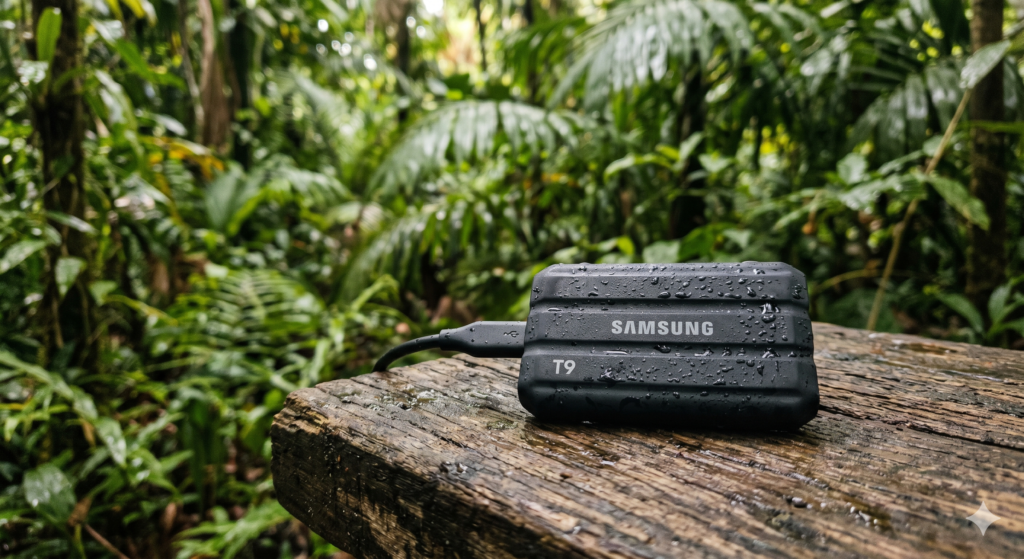
You back up your work religiously, keep your cables organised, and never check your laptop bag. But if you’re running a standard portable SSD through Southeast Asia, the Amazon Basin, or the Caribbean coast, humidity is doing something quiet and destructive to your data that no backup habit fully protects against: it’s corroding the internal contacts, destabilising the NAND flash memory, and — if condensation gets inside the enclosure — introducing the risk of a short-circuit mid-transfer. The right rugged SSD for travel in humid climates isn’t a luxury upgrade. It’s insurance for the files that define your livelihood.
This guide breaks down two drives purpose-built for the realities of high-humidity travel: the Samsung T9 Portable SSD as the premium recommendation, and the SanDisk 1TB Extreme Portable SSD as the capable, compact budget pick.
Quick Comparison: Rugged SSDs for Humid-Climate Travel
| Feature | Samsung T9 Portable SSD | SanDisk 1TB Extreme Portable SSD |
|---|---|---|
| Interface | USB 3.2 Gen 2×2 | USB 3.2 Gen 2 |
| Max Read Speed | 2,000 MB/s | 1,050 MB/s |
| Enclosure Rating | IP65 (dust + water jets) | IP55 (dust + low-pressure water) |
| Drop Resistance | 3 metres | 2 metres |
| Weight | ~98g | ~49g |
| Best Use Case | Full NVMe workflow, large RAW/video transfers | Daily backup, light file management |
| Price Tier | Premium | Budget |
🔋 Premium Pick Samsung T9 Portable SSD The T9 is the drive you reach for when losing a project file isn’t an option. Its IP65-rated enclosure, NVMe-class transfer speeds, and Dynamic Thermal Guard make it the most capable portable drive available for nomads working in genuinely hostile environments. The honest drawback: it requires a USB 3.2 Gen 2×2 host port to hit peak speeds — on older laptops or standard hubs, it performs like a very well-protected mid-range drive. 👉 View Best Price on Amazon.ca
The Samsung T9: NVMe Performance Meets IP65 Protection
Why IP65 and NVMe Together Change the Equation
Most portable SSDs offer one or the other: either fast internal NAND with a basic plastic shell, or ruggedised enclosures around slower flash storage. The Samsung T9 doesn’t compromise. Internally, it runs an NVMe interface — the same protocol used in high-performance internal laptop SSDs — delivering read speeds up to 2,000 MB/s and write speeds up to 1,950 MB/s. Externally, it’s sealed to IP65, meaning it’s fully protected against dust ingress and can handle sustained water jets from any direction. That matters in a tropical context because humidity isn’t just ambient — it’s the sudden downpour that soaks your bag on a scooter in Hanoi, the condensation that forms when you bring a cool drive into a hot, humid room, and the fine salt moisture in coastal air that corrodes unprotected contacts over weeks.
NVMe over USB 3.2 Gen 2×2 achieves its speed through two bonded 10 Gbps lanes, effectively doubling the bandwidth ceiling of standard Gen 2. For a nomad transferring 4K drone footage, large Lightroom catalogs, or VM snapshots between machines, the difference between 500 MB/s and 2,000 MB/s is the difference between a 4-minute transfer and a 40-second one — before your café table neighbour asks if you’re done with the outlet.
Samsung’s Dynamic Thermal Guard is the underappreciated feature here. In high-ambient-temperature environments — think a 34°C co-working space in Chiang Mai with intermittent air conditioning — sustained write operations generate heat that can throttle cheaper drives or, worse, degrade NAND cell reliability over time. The T9’s thermal management actively scales performance to keep temperatures within safe operating range, protecting both speed and long-term drive health.
Real-World Scenario: Overnight Ferry, Gulf of Thailand
You’re on a slow overnight ferry crossing from Koh Samui. The open-air deck is 85% humidity, there’s salt spray, and your bag got wet during boarding. You’re backing up a full day of drone footage — 87GB of ProRes files — from your camera’s CFexpress card to the T9 before you format for tomorrow. Transfer completes in under 90 seconds. The drive’s rubber-sealed enclosure sheds the moisture, the Dynamic Thermal Guard keeps temperatures stable despite the ambient heat, and your footage is safe before you’ve finished your first beer of the crossing.
Pros:
- IP65 full dust and water-jet protection
- 2,000 MB/s read — fastest class of portable drive available
- Dynamic Thermal Guard for sustained reliability in high-heat environments
- 3-metre drop resistance
- Compact rubber-armoured build
Cons:
- Full speed requires USB 3.2 Gen 2×2 — older hubs will bottleneck it
- Slightly heavier than non-rugged competitors at 98g
- Premium price reflects premium protection
| Score | Rating |
|---|---|
| Airport Usability | 5/5 |
| Portability | 4.5/5 |
| Setup Convenience | 4.5/5 |
The SanDisk Extreme: IP55 Protection at a Fraction of the Weight
Where the Budget Pick Earns Its Place
The SanDisk 1TB Extreme Portable SSD is rated IP55 — protected against low-pressure water streams and meaningful dust ingress, though not against sustained water jets or full submersion. At 49g, it’s roughly half the weight of the T9 and disappears into a hip pack or trouser pocket without a second thought. Its 1,050 MB/s read speed via USB 3.2 Gen 2 is genuinely fast for daily workflows: photo culling, document backups, transferring project files between devices, and keeping a working clone of your most critical folders.
The IP55 rating is important to understand accurately. It will handle rain, sweat, splashing, and the occasional brief dunk — but sustained water exposure or high-pressure spray is outside its design tolerance. In humid tropical environments, this means it’s well-suited for most situations you’ll realistically encounter, with the caveat that you shouldn’t leave it loose in an unprotected bag during a monsoon downpour.
Real-World Scenario: Hostel Dorm, Medellin
You’re working from a hostel in Medellin’s rainy season. The open-air common area is consistently humid, your gear gets light spray when the wind shifts, and your bag isn’t waterproof. The SanDisk Extreme sits in your Peak Design Tech Pouch, transfers your daily Lightroom backup in under 3 minutes, and takes zero damage from the ambient moisture. For this use case — regular backups, moderate environmental exposure, no heavy video production — it does exactly what it needs to at a price point that doesn’t sting.
Pros:
- IP55 dust and water resistance covers most real-world tropical scenarios
- 49g — genuinely featherlight
- 1,050 MB/s read handles photography and document workflows cleanly
- 2-metre drop resistance
- Affordable entry point for rugged portable storage
Cons:
- IP55 is not IP65 — sustained water jets or submersion are outside spec
- No thermal management system for sustained large transfers
- Slower speeds make it impractical for large video production workflows
| Score | Rating |
|---|---|
| Airport Usability | 5/5 |
| Portability | 5/5 |
| Setup Convenience | 5/5 |
🛡️ Budget Pick SanDisk 1TB Extreme Portable SSD For nomads who need reliable, moisture-resistant portable storage without a premium price tag, the SanDisk Extreme is the honest choice. It handles everyday tropical humidity, photo and document workflows, and ultralight travel constraints with confidence. Just don’t mistake IP55 for full weatherproofing — if you’re shooting video in the rain or working near the ocean daily, the T9’s IP65 rating is the one you actually need. 👉 View Best Price on Amazon.ca
Head-to-Head: Which Rugged SSD Actually Belongs in Your Bag?
Samsung T9 vs. SanDisk Extreme — The Direct Comparison
The protection gap between IP65 and IP55 sounds incremental but represents a meaningful real-world difference. IP55 handles rain, splashes, and ambient humidity. IP65 handles rain, sustained jets, coastal spray, and the kind of accidental submersion that happens when a bag tips into a street puddle during a Bangkok rainstorm. If your work environment is genuinely tropical — not just occasionally warm — that gap matters.
Speed is the other axis. At 2,000 MB/s, the T9 is purpose-built for video production, large RAW file transfers, and anyone running VM images or large project files. The SanDisk Extreme at 1,050 MB/s is fast enough for photographers, writers, developers managing source code, and any workflow that doesn’t involve moving dozens of gigabytes in a single session.
Best For…
- Video producers and drone operators: Samsung T9. The transfer speed difference is the difference between a usable workflow and a frustrating one.
- Photographers and remote workers: SanDisk Extreme handles Lightroom catalogs, document backups, and mixed media files without breaking stride.
- Ultra-minimalist one-bag travelers: SanDisk Extreme at 49g fits into pockets the T9 won’t.
- Coastal and jungle environments with daily exposure: Samsung T9 — IP65 is the correct spec for genuinely hostile conditions.
Who Each Product Is NOT For
The T9 is not the right choice for travelers who only need basic file portability and are watching every gram and dollar. The SanDisk Extreme is not suitable for sustained professional video production workflows, or for anyone operating in conditions where full water jet or submersion resistance is a realistic risk.
Two Scenarios Where the Right Drive Made All the Difference
Scenario: Co-Working Space, Humid Season, Ho Chi Minh City
Mid-August in Ho Chi Minh City: 90% relative humidity, 37°C outside, and the co-working space’s AC is struggling. You’re editing a 45-minute documentary, scrubbing between a 2TB card and your laptop. The T9 sustains 1,800 MB/s write speeds through a two-hour export session without thermal throttling. The ambient heat that would have slowed a standard drive down to 300 MB/s barely registers. You export, review, and deliver by end of day.
Scenario: Island-Hopping Research Trip, Philippines
You’re documenting remote coastal communities across three islands over two weeks. Your bag gets rained on. A water bottle leaks. One afternoon, a wave catches you and your daypack gets briefly submerged. The SanDisk Extreme — in a zip pouch inside your bag — survives every incident and keeps your interview recordings and location photos intact. It’s not the fastest drive in the world, but on a trip like this, surviving is the spec that matters most.
Build Your Complete Nomad Storage Setup
Pairing a rugged SSD with the right supporting gear turns a single piece of hardware into a complete data protection system. The Ultimate Digital Nomad Gear Guide covers how to build a full travel tech stack that protects your workflow across every environment, while the Best Tech Travel Kit 2026 gets into the specific accessories — cable management, charging, and carry — that keep your gear organised and ready. If you’re refining a minimalist setup where every gram is deliberate, The Minimalist One-Bag Tech Kit maps out how to carry a professional-grade workflow in under 7kg.
Final Summary: Best Rugged SSDs for Humid-Climate Travel
| Product | Tier | Best For | |
|---|---|---|---|
| Samsung T9 Portable SSD | Premium | Video production, IP65 environments, NVMe-speed workflows | View on Amazon.ca |
| SanDisk 1TB Extreme Portable SSD | Budget | Photography, daily backups, ultralight travel, moderate humidity | View on Amazon.ca |
Choosing the right rugged SSD for travel in humid climates comes down to an honest assessment of your conditions and your workflow. If you’re producing video, working near the ocean, or operating in environments where your gear regularly faces real water exposure, the T9’s IP65 rating and NVMe speeds justify every dollar of the premium. If your work is lighter and your environment is merely tropical rather than hostile, the SanDisk Extreme delivers reliable protection in a package that weighs less than a granola bar.
Your data doesn’t care how careful you are. The enclosure around it does.
Pingback: Best Travel Router for Digital Nomads in 2026: Take Control of Every Network You Touch - techtravelkit.com
Precisely what I was searching for, appreciate it for putting up.