
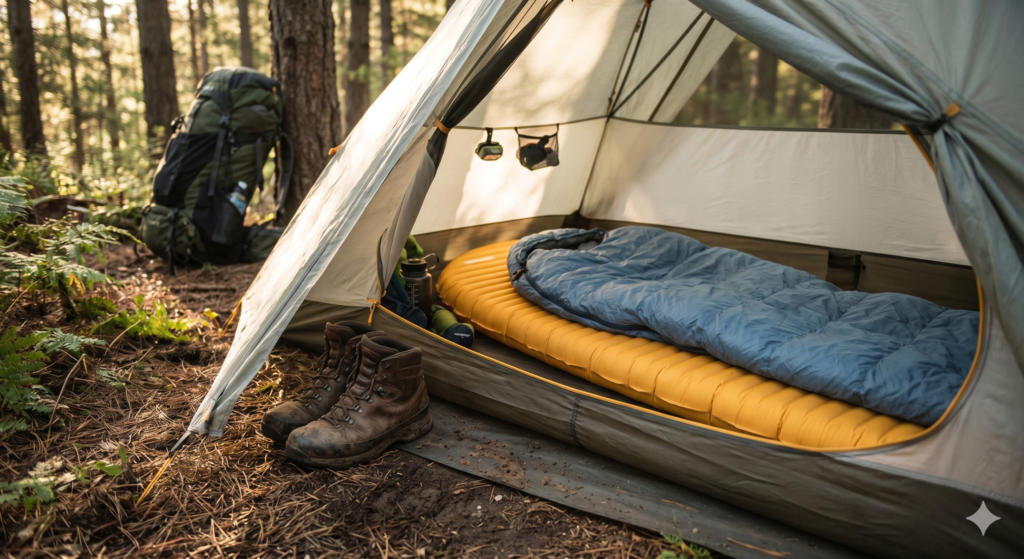
A bad night’s sleep in a tent doesn’t just ruin your morning — it compounds across every day of a multi-night trip until the whole experience feels like an endurance test rather than an adventure. The ground is colder, harder, and more uneven than it looks from the trailhead, and the sleeping pad between you and it is the single most underestimated piece of gear in most campers’ kits. The best sleeping pad for camping balances insulation, weight, comfort, and packability in ways that differ dramatically across price points — and the right choice depends heavily on how you camp, not just how much you want to spend.
This guide compares three sleeping pads that cover the full spectrum: the Therm-a-Rest NeoAir XLite for ultralight backpackers who count every gram, the EXPED MegaMat 10 for car campers and base camp setups who prioritise sleep quality above all else, and the Sleepingo Sleeping Pad for budget-conscious campers taking their first steps beyond a foam roll.
Quick Comparison: All Three Sleeping Pads at a Glance
| Product | Type | R-Value | Weight | Packed Size | Best For | Tier |
|---|---|---|---|---|---|---|
| Therm-a-Rest NeoAir XLite | Inflatable | 4.5 | ~354g | Fist-sized | Ultralight backpacking | Premium |
| EXPED MegaMat 10 | Self-inflating foam | 8.0 | ~1.9kg | Large roll | Car camping, base camp | Mid-Range |
| Sleepingo Sleeping Pad | Inflatable | 2.0 | ~510g | Compact | Budget backpacking, casual camping | Budget |
Therm-a-Rest NeoAir XLite: The Ultralight Benchmark
The NeoAir XLite has held its position as the reference point for ultralight inflatable sleeping pads for years — and the reason comes down to a single metric that matters more than any other in cold-weather camping: R-value. An R-value of 4.5 means the NeoAir XLite is genuinely four-season capable, blocking heat transfer from your body to the ground effectively enough for below-freezing temperatures. Most pads in its weight class offer R-values of 2.0–3.0, which handle summer but struggle the moment temperatures drop seriously.
Therm-a-Rest achieves this through its Triangular Core Matrix construction — a pattern of air chambers arranged in a triangular grid that traps warm air in a structure that resists both convection and conduction. The result is exceptional thermal performance in a pad that compresses to roughly the size of a large water bottle and weighs 354 grams. For a backpacker counting every gram on a multi-day route, that combination is genuinely difficult to beat at any price.
The NeoAir XLite is not a quiet pad — the crinkle of its material is audible when you shift positions, which light sleepers find disruptive in shared tent setups. It’s also a precision piece of gear that rewards proper inflation and careful handling. A small puncture in the backcountry without a patch kit ends your comfort for the trip.
Consistently rated 4.6★ across thousands of Amazon.ca reviews, with particular praise from thru-hikers and alpinists for the warmth-to-weight ratio.
Real-World Scenario: Multi-Day Backcountry Route, Banff National Park
Night three of a five-day backcountry loop. Temperatures drop to -2°C overnight. Your tent partner’s budget pad has them awake and shivering by 3am while you sleep through to sunrise on the NeoAir XLite, fully rested and ready for the longest day of the route. The 354g weight penalty over a foam pad paid for itself the moment the temperature dropped below freezing.
Pros:
- R-value 4.5 — genuine four-season warmth in a sub-400g package
- Triangular Core Matrix construction maximises thermal efficiency
- Compresses to fist-sized for pack integration
- Durable WingLock valve for precise inflation control
Cons:
- Audible crinkle noise when shifting positions
- Highest price in the category
- Requires careful handling — puncture vulnerable without a ground sheet
| Score | Rating |
|---|---|
| Trail Readiness | 5/5 |
| Portability | 5/5 |
| Value for Money | 3.5/5 |
| Best-Use-Case Fit | 5/5 |
🏕️ Premium Pick Therm-a-Rest NeoAir XLite For backpackers doing serious multi-day routes in variable or cold conditions, the NeoAir XLite is the sleeping pad that removes thermal performance as a limiting factor — at a weight that doesn’t punish you on the climb. The noise is real and the price is real. The warmth-to-weight ratio is unmatched. 👉 View Best Price on Amazon.ca
EXPED MegaMat 10: When Sleep Quality Is the Priority
The EXPED MegaMat 10 operates from a completely different premise than the NeoAir XLite. Where the Therm-a-Rest optimises for weight, the MegaMat 10 optimises for sleep quality — and it does so with an approach that’s closer to a mattress than a camping pad. Its 10cm of self-inflating open-cell foam delivers a sleeping surface that most car campers describe as the best sleep they’ve ever had outdoors — comparable to a firm hotel mattress rather than the compressible foam of a budget roll.
The R-value of 8.0 is the highest in this comparison and one of the highest available in any portable sleeping pad category. Self-inflating foam construction means no pump required — open the valve and the foam expands on its own over 10–15 minutes, reaching near-full inflation without any input from you. A brief top-up breath through the valve brings it to perfect firmness.
At 1.9kg and a packed size equivalent to a large sleeping bag, the MegaMat 10 is unambiguously a car camping or base camp product. It doesn’t belong in a backpack unless that backpack is being carried from a car to a fixed campsite. For that specific use case, it’s the most comfortable camping sleep system available at this price point.
Consistently rated 4.7★ on Amazon.ca, with strong reviews from couples, families, and anyone who camps from a vehicle and refuses to compromise on sleep quality.
Real-World Scenario: Four-Day Car Camping Trip, Algonquin Provincial Park
A four-day canoe camping trip — everything loaded into canoes rather than backpacks, which removes the weight penalty entirely. The MegaMat 10 unrolls at the campsite, self-inflates while you set up the rest of camp, and delivers a genuinely restorative night’s sleep for all four nights. Your group wakes energised for paddling days rather than stiff and sleep-deprived.
Pros:
- R-value 8.0 — exceptional insulation for cold nights
- 10cm foam depth delivers mattress-like comfort
- Self-inflating — no pump required
- Extremely durable construction for long-term use
Cons:
- 1.9kg and large packed size — strictly car camping or base camp
- Higher price than most car camping alternatives
- Takes 10–15 minutes to fully self-inflate
| Score | Rating |
|---|---|
| Trail Readiness | 1.5/5 |
| Portability | 2/5 |
| Value for Money | 4/5 |
| Best-Use-Case Fit | 5/5 |
🏕️ Mid-Range Pick EXPED MegaMat 10 The MegaMat 10 is the right sleeping pad for campers who drive to their site and refuse to accept that camping means sleeping badly. For everything it does in terms of comfort and insulation, it’s excellent value — the caveat is simply that it belongs in a car, not on your back. 👉 View Best Price on Amazon.ca
Sleepingo Sleeping Pad: Capable Entry-Level Performance
The Sleepingo Sleeping Pad targets first-time backpackers and budget-conscious campers who need a functional inflatable pad without spending premium prices. At 510g and an R-value of 2.0, it covers the summer camping brief cleanly — warm nights in Canadian provincial parks, festival camping, and casual overnight trips where extreme cold isn’t a factor. For a camper whose trips run from late May through early September in moderate temperatures, the Sleepingo delivers a meaningfully better sleep surface than a foam roll at a price that makes it an easy first upgrade.
The R-value of 2.0 is the honest limitation. It works confidently in temperatures above 10°C but starts to feel thermally inadequate below that threshold as ground cold bleeds through. The inflation valve works efficiently — full inflation in about 10 breaths — and the surface is comfortable enough for side sleepers in most conditions.
Durability is adequate rather than exceptional. The material handles normal camping use well, but it’s not built for the abrasive terrain or high-repetition use that the NeoAir XLite handles without complaint. For occasional summer camping it’s a sound investment. For serious or frequent use, the step up to the NeoAir XLite is worth the cost.
Consistently rated 4.3★ on Amazon.ca, with strong reviews from casual campers, festival-goers, and first-time backpackers for value and ease of use.
Real-World Scenario: Summer Weekend Camping, Algonquin Campground
A long weekend at a drive-in campsite with friends. Temperatures sit at 15°C overnight. The Sleepingo inflates in 30 seconds, provides a comfortable night’s sleep, and packs back down quickly in the morning. For a first camping trip or an occasional summer outing where comfort matters more than extreme performance, it does exactly what it needs to.
Pros:
- Affordable entry point for inflatable sleeping pads
- 510g — lighter than most foam alternatives
- Quick inflation and deflation
- Comfortable surface for summer temperature camping
Cons:
- R-value 2.0 — not suitable for cold weather camping
- Less durable material than premium alternatives
- Slightly heavier than premium ultralight options
| Score | Rating |
|---|---|
| Trail Readiness | 3/5 |
| Portability | 4/5 |
| Value for Money | 5/5 |
| Best-Use-Case Fit | 3.5/5 |
🏕️ Budget Pick Sleepingo Sleeping Pad For summer camping in moderate temperatures, the Sleepingo is a capable first sleeping pad that delivers a real upgrade over sleeping directly on tent floor. Know its R-value ceiling and plan your trips accordingly — it’s not a cold-weather pad, but within its operating range it earns its price. 👉 View Best Price on Amazon.ca
Our Verdict: Which Sleeping Pad Should You Buy?
Best Overall: EXPED MegaMat 10. For most campers who drive to their site, the MegaMat 10 delivers a sleep quality that genuinely changes how you feel about camping. The weight is irrelevant when you’re loading a car, and the comfort and insulation are unmatched at the price.
Best Premium: Therm-a-Rest NeoAir XLite. For backpackers who need four-season warmth in a sub-400g package, there is no better option. The price is high and the noise is real — but the warmth-to-weight ratio justifies both.
Best Budget: Sleepingo Sleeping Pad. For occasional summer camping or a first-time camper testing the waters before committing to a premium pad, the Sleepingo covers the basics cleanly without overcommitting budget.
Head-to-Head: Choosing by Camping Style
The weight gap between the NeoAir XLite and the Sleepingo is modest — 354g vs 510g — but the R-value gap is enormous: 4.5 vs 2.0. For spring and autumn camping that gap is the difference between a warm night and a miserable one. The single most important question to ask before buying a sleeping pad is not “how much does it weigh?” but “what’s the coldest night I’ll sleep on this?”
Best For…
- Multi-day backpacking, all seasons: Therm-a-Rest NeoAir XLite — weight and warmth both matter.
- Car camping, canoe camping, base camp: EXPED MegaMat 10 — comfort and insulation without weight compromise.
- First-time campers, summer festivals, casual overnights: Sleepingo — functional, affordable, and fits the occasion.
- Cold-weather backpacking on a budget: Neither the Sleepingo nor the budget market serves this well — the NeoAir XLite is the honest answer even at its price.
Who Each Product Is NOT For
The NeoAir XLite is not for campers who run hot and camp in summer only — the warmth premium doesn’t pay off and the noise remains. The MegaMat 10 is not for anyone covering distance on foot. The Sleepingo is not for anyone camping below 10°C.
Two Nights, Three Very Different Outcomes
Scenario: Early June Backpacking, Bruce Trail, Ontario
Night temperatures sit at 5°C. The NeoAir XLite camper sleeps through comfortably on R-4.5 insulation. The Sleepingo camper wakes twice and spends the last two hours in their sleeping bag fully dressed. The MegaMat 10 camper didn’t bring it — at 1.9kg it was never going in the backpack.
Scenario: August Long Weekend, Killbear Provincial Park, Ontario
Drive-in site, car packed to the roof, temperatures at 18°C overnight. The MegaMat 10 unrolls, self-inflates, and delivers the best sleep anyone in the group has had outdoors. The NeoAir XLite camper sleeps well too but paid significantly more for the same comfortable summer night.
Whatever your camping style, the right sleeping pad is available now on Amazon.ca — Therm-a-Rest NeoAir XLite → for backpackers, EXPED MegaMat 10 → for car campers, and Sleepingo → for casual summer trips.
Final Summary: Best Sleeping Pad for Camping in 2026
| Product | Tier | Best For | |
|---|---|---|---|
| Therm-a-Rest NeoAir XLite | Premium | Ultralight backpacking, four-season warmth, long routes | View on Amazon.ca |
| EXPED MegaMat 10 | Mid-Range | Car camping, canoe camping, maximum comfort | View on Amazon.ca |
| Sleepingo Sleeping Pad | Budget | Summer camping, first-time campers, casual overnights | View on Amazon.ca |
The best sleeping pad for camping is the one matched to your actual camping style and temperature range — not the lightest or the cheapest. All three ship to Canada with Prime, so whichever fits your next trip is one order away.
Your sleeping pad is only part of a great camp sleep system. The best air mattress for camping guide covers the comfort-first alternative for car campers who want even more cushioning. For keeping your camping gear and tech organised on any trip, the must-have travel gadgets guide covers the pouches and organisers that make camp life efficient. And if you’re planning a longer adventure that mixes camping with remote work, the ultimate digital nomad gear guide covers the full kit.
Pingback: Best Camping Tent in 2026: Ultralight Backpacking to Family Car Camping Compared - techtravelkit.com
Pingback: The 80-Kilometer Trap: Why Standard Tents Are Destroying Your Ride - techtravelkit.com
After all, what a great site and informative posts, I will upload inbound link – bookmark this web site? Regards, Reader.