
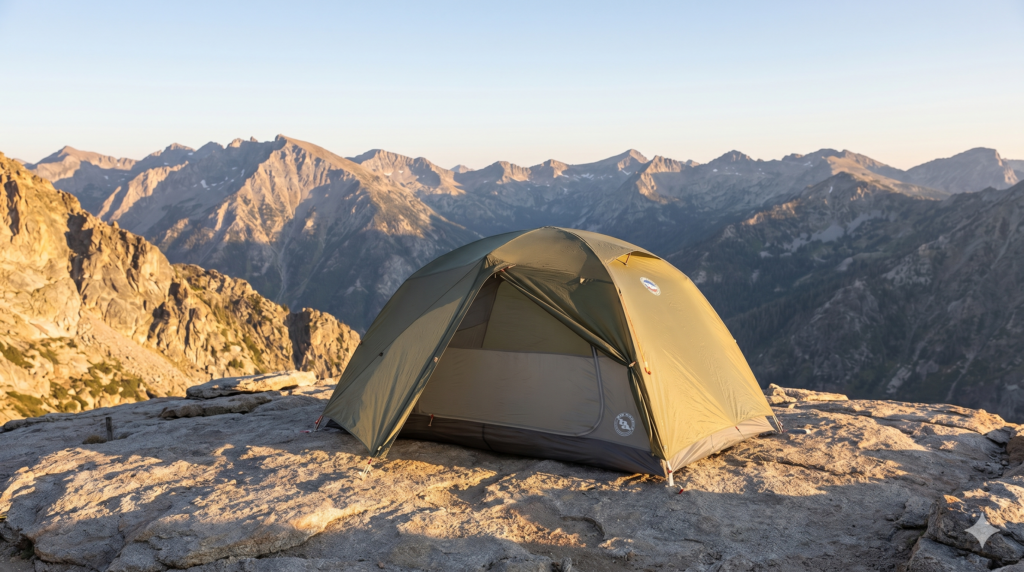
A tent is the single most consequential piece of gear in your camping kit. Everything else — your sleeping pad, your stove, your clothing — can be imperfect and the trip still works. A tent that leaks in a storm, collapses under wind, or suffocates you with heat on a warm night doesn’t just cause discomfort — it ends the trip. The best camping tent for your situation depends on how you get to camp, how many people sleep in it, and what weather conditions you’re likely to face.
This guide compares four tents across the full spectrum: the Big Agnes Copper Spur HV UL for ultralight backpackers who treat every gram as a deliberate decision, the MSR Hubba Hubba Bikepack 2 as the mid-range freestanding option for bikepacking and technical outdoor use, the Coleman Skydome 4-Person as the best-value car camping tent for families and groups, and the Amazon Basics Dome Tent as the ultra-budget entry point for occasional or first-time campers.
Quick Comparison: All Four Tents at a Glance
| Product | Capacity | Weight | Setup | Weather Rating | Tier |
|---|---|---|---|---|---|
| Big Agnes Copper Spur HV UL | 2 person | ~1.0kg | Freestanding | 3-season | Premium |
| MSR Hubba Hubba Bikepack 2 | 2 person | ~1.2kg | Freestanding | 3-season | Mid-Range |
| Coleman Skydome 4-Person | 4 person | ~4.5kg | Freestanding | 3-season | Budget |
| Amazon Basics Dome Tent | 4 person | ~3.2kg | Freestanding | Fair weather | Ultra-Budget |
Big Agnes Copper Spur HV UL: The Ultralight Benchmark
The Big Agnes Copper Spur HV UL occupies a category where most tents fail: genuinely comfortable two-person living space in a package that weighs approximately one kilogram. Its high-volume hub design creates vertical walls that maximise usable interior space despite the minimal material — you can sit upright comfortably near the centre, stow gear along the sides, and move without the cramped sensation that plagues lighter tents that sacrifice headroom for weight.
The ripstop nylon construction with silicone coating achieves its sub-kilogram weight without compromising the structural integrity needed for real weather. Seam-taped construction and a full-coverage fly create a weather-resistant shelter that handles sustained rain on three-season routes — not a bombproof winter tent, but more than adequate for conditions from spring shoulder season through late autumn.
The mtnGLO lighting system — an optional integrated LED light strip woven into the tent fabric — is an underappreciated feature for backcountry camping. It eliminates the headlamp fumbling that characterises tent life after dark and provides enough ambient light for reading, organising gear, and socialising without blinding your tent partner.
Consistently rated 4.7★ across thousands of Amazon.ca reviews, with particular praise from thru-hikers, ultralight backpackers, and bikepacking adventurers for the weight-to-livability ratio.
Real-World Scenario: Five-Day Backpacking Route, West Coast Trail, BC
Each day covers 12–15 kilometres with significant elevation. At 1.0kg, the Copper Spur represents a 2–3kg savings over a comparable standard backpacking tent — savings felt in every leg on every uphill. At camp, the high-volume design provides enough room for two adults to sit upright, eat dinner inside during a rain event, and store wet gear in the vestibule without cross-contaminating the sleeping area.
Pros:
- ~1.0kg — lightest capable two-person tent in the category
- High-volume design maximises interior livability at minimum weight
- Full-coverage fly for genuine 3-season weather protection
- Seam-taped construction — no rain penetration at seams
- Optional mtnGLO integrated lighting
Cons:
- Premium price — the highest in this comparison by a significant margin
- Requires careful handling — ultralight materials puncture more easily
- Not suitable for winter or heavy snow load
- Two-person capacity is genuinely for two — no extra space for gear
| Score | Rating |
|---|---|
| Trail Readiness | 5/5 |
| Portability | 5/5 |
| Value for Money | 3/5 |
| Best-Use-Case Fit | 5/5 |
⛺ Premium Pick Big Agnes Copper Spur HV UL For backpackers and bikepackers who count grams and need genuine living space at camp, the Copper Spur is the tent that resolves the weight-vs-comfort tension better than anything else in its class. The price is real. The weight saving across a five-day route is equally real. 👉 View Best Price on Amazon.ca
MSR Hubba Hubba Bikepack 2: Purpose-Built for Loaded Outdoor Travel
The MSR Hubba Hubba Bikepack 2 addresses a specific and growing camping context: the bikepacker or cycle tourer who needs a compact, freestanding shelter that attaches to a loaded bike without requiring panniers or a trailer. Its packable geometry divides the tent body, poles, and fly into separate stuff sacks designed to distribute across frame bags, handlebar bags, and seat packs rather than requiring a single large compression sack. For bikepacking specifically, this distribution flexibility is the feature that makes the MSR the correct tent — no other design consideration matters as much.
For non-bikepackers, the Hubba Hubba’s freestanding design and 1.2kg weight still make it an excellent mid-range backpacking tent. The two-door, two-vestibule design gives each tent occupant their own entry and gear storage area — a quality-of-life feature that premium minimalist tents often sacrifice for weight. The aluminium pole system is stiffer and more wind-resistant than carbon fibre alternatives at equivalent weight, providing better structural stability in exposed camping locations.
Seam-taped ripstop construction and a full-coverage fly deliver the same 3-season weather capability as the Copper Spur at marginally more weight. The honest trade-off versus the Big Agnes is 200 grams more weight for a meaningful improvement in weather resistance and structural stability.
Consistently rated 4.6★ on Amazon.ca, with strong reviews from bikepackers, cycle tourers, and multi-day backpackers for the distribution pack system and freestanding setup.
Real-World Scenario: Trans-Canada Bike Tour, Ontario to BC
A 45-day coast-to-coast cycle tour. The Hubba Hubba’s separate stuff sacks distribute across the handlebar bag and frame bag — no single large item to manage on a loaded bike. Setup at each campsite takes under four minutes — the freestanding design doesn’t require stakes for initial pitching, which matters on hard-packed or rocky soil where staking is difficult. Weather capability handles everything from prairie thunderstorms to BC mountain rain.
Pros:
- Separate packable geometry — distributes across multiple bike bags
- Two-door, two-vestibule design — each occupant has independent access
- Freestanding — stakes not required for initial setup
- Aluminium poles provide better wind resistance than carbon alternatives
- Full 3-season weather capability
Cons:
- 200g heavier than the Copper Spur at similar capacity
- Higher price than car camping alternatives
- Two-person capacity only — not a family or group option
- Bikepack-specific design features are wasted weight for non-bikepackers
| Score | Rating |
|---|---|
| Trail Readiness | 5/5 |
| Portability | 4.5/5 |
| Value for Money | 4/5 |
| Best-Use-Case Fit | 5/5 |
⛺ Mid-Range Pick MSR Hubba Hubba Bikepack 2 For bikepackers and cycle tourers, the Hubba Hubba is the correct tent — the distributed pack system solves the storage problem that standard stuff sacks create on a loaded bike. For general backpacking, it’s a strong mid-range option that trades 200g over the Copper Spur for better weather resistance and two-door access. 👉 View Best Price on Amazon.ca
Coleman Skydome 4-Person: The Car Camping Standard
The Coleman Skydome 4-Person is not trying to be an ultralight backpacking tent. At 4.5kg it doesn’t belong in a backpack — it belongs in the boot of a car, where its weight is irrelevant and its features become genuinely compelling. The nearly vertical walls of the Skydome design create 20% more interior volume than standard dome tents at equivalent floor area — a meaningful difference when four people are sharing the space, particularly if any of them are adults who want to move around without crawling.
Pre-attached poles snap into position and the tent rises in under five minutes — a setup speed that matters when you’re arriving at a campground after dark with tired children. The Coleman Skydome’s E-Port allows power cable management into the tent from an external power source — relevant for car camping with a portable power station or camp-provided electrical hookups.
The weather rating is honest for a car camping tent: it handles moderate rain confidently but isn’t designed for sustained heavy weather or exposed camping locations. For provincial park campgrounds with tree cover and car access, it covers every realistic weather scenario a family is likely to encounter.
Consistently rated 4.5★ on Amazon.ca, with strong reviews from families, casual campers, and festival attendees for setup speed, interior volume, and value.
Real-World Scenario: Four-Day Family Camping Trip, Sandbanks Provincial Park
Two adults, two children, four nights. The Skydome’s nearly vertical walls create enough interior space for a family of four to move around comfortably — adults can stand near the centre. Setup completes in six minutes without reading the instructions. The E-Port allows a small fan to run on a warm night from the car’s portable power bank. No rain penetration across two moderate overnight showers.
Pros:
- Nearly vertical walls maximise interior volume for four people
- Setup in under five minutes — pre-attached poles
- E-Port for external power management
- Excellent value for four-person capacity
- Fits four camping pads and gear comfortably
Cons:
- 4.5kg — strictly car camping, not portable
- Not rated for heavy weather or exposed locations
- Less durable than premium alternatives over multiple seasons
- Limited vestibule storage for gear outside sleeping area
| Score | Rating |
|---|---|
| Trail Readiness | 1/5 |
| Portability | 2/5 |
| Value for Money | 5/5 |
| Best-Use-Case Fit | 5/5 |
⛺ Budget Pick Coleman Skydome 4-Person For family car camping in provincial parks and established campgrounds, the Skydome is the best value tent in its category — fast setup, generous interior space, and reliable weather performance for the conditions car campers actually face. Don’t take it backpacking. Don’t take it to an exposed ridgeline. For everything else, it’s the right call. 👉 View Best Price on Amazon.ca
Amazon Basics Dome Tent: The Entry-Level Option for Occasional Campers
The Amazon Basics Dome Tent occupies the entry point of the camping tent market — a functional shelter for fair-weather occasional camping at a price that makes it a zero-regret purchase for someone testing whether they enjoy camping before investing in premium gear. It pitches correctly in under ten minutes, keeps light rain and dew off four occupants, and provides enough interior space for a family to sleep comfortably in mild summer conditions. That’s the honest brief, and within it the tent succeeds.
The weather tolerance is limited — moderate drizzle is manageable, sustained rain or wind is not. The pole system is less robust than the Coleman’s, which translates to less structural stability in uneven or gusty conditions. The floor material is thinner than premium alternatives, which means a ground sheet is worth adding for anything beyond flat, grassy pitching surfaces.
For a first camping trip, a occasional summer weekend, or a child’s backyard camping adventure before the family commits to a proper tent, the Amazon Basics Dome represents an appropriate entry-level investment. It’s not a tent to grow into — it’s a tent to start with.
Consistently rated 4.2★ on Amazon.ca, with honest reviews from first-time campers and occasional users who appreciate the price point and basic functionality.
Real-World Scenario: First Family Camping Trip, Ontario Campground
Two adults, two children, one night. Mild summer evening, no significant weather. The tent pitches correctly, all four sleep comfortably, and the family discovers they enjoy camping enough to invest in a Coleman Skydome for the following season. The Amazon Basics tent served its purpose — giving the family a low-cost way to test the experience before committing meaningful budget.
Pros:
- Most affordable entry point in the category
- Adequate for fair weather summer camping
- Setup in under ten minutes
- Sufficient interior space for four in mild conditions
- Zero-regret price for occasional or first-time use
Cons:
- Not suitable for sustained rain or wind
- Thinner floor material — ground sheet recommended
- Less durable than any other tent in this comparison
- Limited vestibule and storage options
| Score | Rating |
|---|---|
| Trail Readiness | 1/5 |
| Portability | 3/5 |
| Value for Money | 4/5 |
| Best-Use-Case Fit | 3/5 |
⛺ Ultra-Budget Pick Amazon Basics Dome Tent For a first camping experience or an occasional fair-weather outing where budget is the primary constraint, the Amazon Basics Dome Tent provides a functional shelter that earns its price. Understand its weather limitations before you commit to a forecast-dependent trip. 👉 View Best Price on Amazon.ca
Our Verdict: Which Camping Tent Is Right for You?
Best Overall: Coleman Skydome 4-Person. For the majority of Canadian campers who drive to provincial park campgrounds with family or friends, the Skydome’s interior volume, five-minute setup, and outstanding value make it the most practical tent in this comparison. Weight is irrelevant when you’re loading a car.
Best Premium: Big Agnes Copper Spur HV UL. For backpackers and bikepackers for whom every gram compounds across multi-day routes, the Copper Spur’s weight-to-livability ratio is unmatched. The price is high — the weight saving across a five-day route is tangible.
Best Mid-Range: MSR Hubba Hubba Bikepack 2. For bikepackers specifically, the distributed pack system is the decisive feature. For general backpacking, it’s an excellent two-person tent that trades minimal weight versus the Copper Spur for better weather resistance and two-door access.
Best Ultra-Budget: Amazon Basics Dome Tent. For a first camping trip or occasional fair-weather use where budget is the constraint, the Amazon Basics provides functional shelter without significant financial commitment.
The Most Important Question Before Buying a Tent
The single question that determines your correct tent is: how do you get to camp?
If you drive, weight is irrelevant and the Coleman Skydome or Amazon Basics serves you well at dramatically lower cost than a backpacking tent. If you hike or bike, every gram you carry compounds across every kilometre, and the premium for the Copper Spur or Hubba Hubba pays for itself in reduced fatigue across a multi-day route.
Best For…
- Car camping families, provincial park regulars: Coleman Skydome — space, speed, and value define this category.
- Multi-day backpackers, ultralight hikers: Big Agnes Copper Spur HV UL — weight-to-livability defines this category.
- Bikepackers, cycle tourers: MSR Hubba Hubba Bikepack 2 — distributed pack geometry defines this category.
- First-time campers, occasional fair-weather outings: Amazon Basics Dome — price and function define this category.
Who Each Product Is NOT For
The Copper Spur is not for car campers — the premium pays for weight saving that driving eliminates. The Hubba Hubba’s bikepack features are wasted weight on foot. The Skydome is not for anywhere you have to carry it. The Amazon Basics is not for any trip where weather reliability is a genuine requirement.
Four Scenarios, Four Right Tents
Scenario: Weekend Backpacking, Algonquin Wilderness Trail Two adults, 18km per day, 3-night route. The Copper Spur’s 1.0kg weight represents a 2kg saving over a standard backpacking tent — felt on every climb. Camp comfort is genuinely good despite the minimal pack size.
Scenario: Coast-to-Coast Bikepacking, Ontario to Quebec 14-day loaded bike tour. The Hubba Hubba distributes across frame and handlebar bags — no single large bag required. Freestanding setup on gravel shoulders and hard-packed areas at 10pm after long days.
Scenario: May Long Weekend, Sandbanks Provincial Park Two adults, two kids, car loaded at the campground. The Skydome rises in five minutes at 8pm after the drive, feeds four inside during a brief evening shower, and provides enough room for the full family to coexist comfortably for three nights.
Scenario: First Overnight Camping Trip, Backyard Trial Run Two adults testing whether they enjoy camping before buying proper gear. The Amazon Basics Dome provides a functional shelter for a warm summer night — enough to confirm they want to invest in something better for next season.
For car camping families, the Coleman Skydome is available now on Amazon.ca — Coleman Skydome 4-Person →
Final Summary: Best Camping Tent in 2026
| Product | Tier | Best For | |
|---|---|---|---|
| Big Agnes Copper Spur HV UL | Premium | Ultralight backpacking, weight-critical routes, bikepack | View on Amazon.ca |
| MSR Hubba Hubba Bikepack 2 | Mid-Range | Bikepacking, cycle touring, two-door backpacking tent | View on Amazon.ca |
| Coleman Skydome 4-Person | Budget | Car camping families, provincial parks, fast setup | View on Amazon.ca |
| Amazon Basics Dome Tent | Ultra-Budget | First-time campers, fair-weather occasional use | View on Amazon.ca |
The best camping tent is the one matched to how you travel to camp and who travels with you. All four ship to Canada with Prime — whichever fits your camping style is ready before your next trip.
Complete your camp setup with the right sleep system. The best sleeping pad for camping covers the ground insulation that pairs with your new tent. For keeping your camp gear charged on multi-day trips without power access, the best portable power station guide covers your camp power options. And for tracking your tent and gear at busy campgrounds, the best gear tracker for camping ensures nothing walks off without your knowledge.
it is a particular-entry