
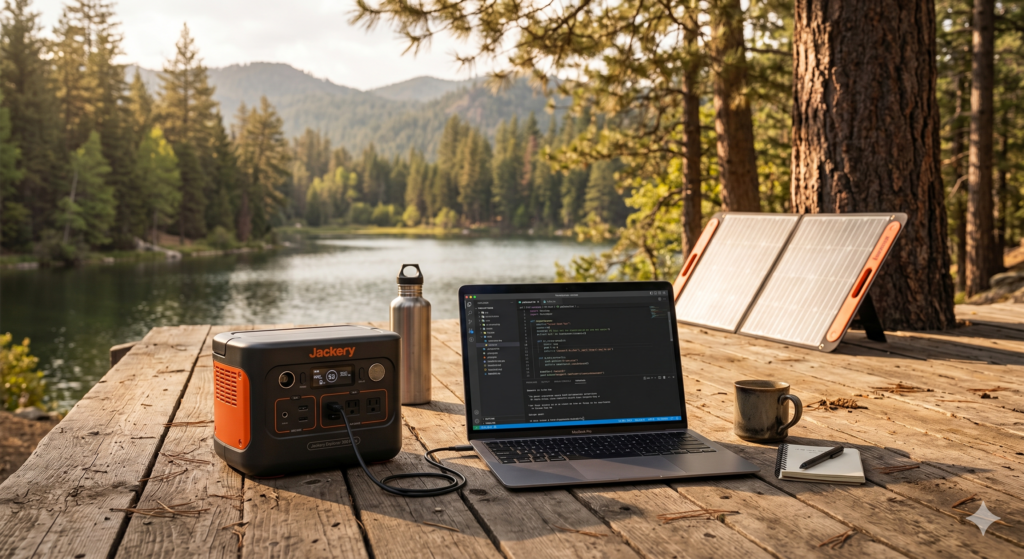
Cafés have outlets. Co-working spaces have outlets. Hotels have outlets. The moment your work takes you somewhere none of those exist — a cabin without shore power, a remote filming location, a van parked at a trailhead — your entire mobile office collapses unless you brought your own electricity. The best portable power station for remote work isn’t backup power; it’s the infrastructure that makes genuinely off-grid work possible rather than aspirational.
This guide compares two power stations built for nomads who mean it: the Jackery Explorer 300 Plus as the premium pick, and the Anker 521 PowerHouse as the reliable, compact budget option.
At a Glance: Premium vs. Budget Portable Power Station
| Feature | Jackery Explorer 300 Plus | Anker 521 PowerHouse |
|---|---|---|
| Capacity | 288Wh | 256Wh |
| AC Output | 300W (600W surge) | 200W (400W surge) |
| USB-C Output | 100W PD | 60W PD |
| Solar Input | Yes (up to 200W) | Yes (up to 65W) |
| Weight | ~3.75kg | ~3.48kg |
| Best Use Case | Full laptop + devices, solar charging, sustained work | Light to medium loads, budget off-grid setup |
| Price Tier | Premium | Budget |
⚡ Premium Pick Jackery Explorer 300 Plus The Explorer 300 Plus is the power station that closes the gap between “camping battery” and “genuine mobile office infrastructure.” Its 300W AC output handles laptops, monitors, and lighting simultaneously, and its 200W solar input means the right panel setup can keep it topped up indefinitely in good conditions. The honest drawback: at 3.75kg it’s not something you’ll carry in a backpack — it belongs in a bag, a van, or a base camp. 👉 View Best Price on Amazon.ca
Jackery Explorer 300 Plus: Off-Grid Power That Means Business
Understanding Watt-Hours, AC Output, and Why Both Numbers Matter
Most people look at capacity (Wh) and miss the number that actually limits their workflow: AC output wattage. A power station can have 500Wh of capacity but if its AC inverter only outputs 100W, it can’t run a 90W laptop at full load — the inverter will throttle or shut down. The Explorer 300 Plus pairs 288Wh of capacity with a 300W continuous AC output and 600W surge tolerance, which means it can simultaneously run a MacBook Pro (96W), a portable monitor (10–15W), and a desk lamp (20W) without breaking a sweat.
The 100W USB-C PD output is equally important. At 100W over USB-C, the Explorer charges a MacBook Pro at full speed directly — no AC adapter needed, no efficiency loss through the inverter chain. This matters because AC inverter conversion loses roughly 10–15% of stored energy as heat. Bypassing the inverter for USB-C charging preserves capacity and extends your working time per charge cycle.
Solar input at up to 200W means the Explorer 300 Plus can pair with a quality foldable solar panel and achieve meaningful recharge rates in clear-sky conditions — enough to offset a moderate workload indefinitely in sunny climates. For nomads working from vans, boats, or fixed remote locations, this turns the power station from a finite resource into a sustainable one.
Consistently rated 4.7★ across Amazon.ca reviews, with particular praise from van-lifers, remote filmmakers, and off-grid remote workers for reliability and solar integration.
Real-World Scenario: Remote Cabin Work Week, Canadian Rockies
A week-long writing and editing retreat in a cabin outside Banff — no shore power, no generator. The Explorer 300 Plus arrives fully charged. Day one: MacBook Pro running eight hours on USB-C output, portable monitor on AC, work lamp running throughout. End of day: 35% remaining. A 100W solar panel on the south-facing cabin window recovers 180Wh through the following morning’s sun. Day two begins at 90%. The pattern sustains for the full week without a single wall outlet.
Pros:
- 300W AC output handles full laptop + monitor + lighting simultaneously
- 100W USB-C PD bypasses inverter for efficient laptop charging
- 200W solar input enables sustainable off-grid operation
- LiFePO4 battery chemistry — safer and longer cycle life than standard lithium
- Clear LCD display shows input, output, and remaining runtime
Cons:
- 3.75kg — not a carry-in-a-backpack device
- Solar panel sold separately — full solar setup requires additional investment
- Higher price point than comparable capacity competitors
| Score | Rating |
|---|---|
| Airport Usability | 3/5 |
| Portability | 3.5/5 |
| Setup Convenience | 4.5/5 |
| Value for Travel | 4/5 |
Anker 521 PowerHouse: Compact, Capable, and Honestly Priced
Where the Budget Pick Earns Its Place in a Nomad Kit
The Anker 521 PowerHouse sits in the sweet spot between a power bank and a full power station. At 256Wh and 3.48kg it’s marginally lighter than the Explorer, but its 200W AC output and 60W USB-C PD are the real differentiators from a standard power bank. For nomads whose off-grid power needs are moderate — one laptop, one phone, maybe a small light — the 521 PowerHouse covers the brief at a price that doesn’t require justification.
The 60W USB-C PD output charges most laptops at reduced-but-functional rates. A MacBook Air M5 charging at 60W will fill from 20% to 80% in roughly 90 minutes — slower than wall speed but perfectly adequate for a morning work session while the unit itself recovers on solar input. The 65W solar input ceiling is the meaningful limitation: in a full day of direct sun, a 60W panel adds approximately 50–55Wh after conversion losses, which covers roughly two hours of laptop use. Adequate for top-up; not sufficient for sustained high-load operation.
Anker’s build quality and safety systems are well-established in the power category, and the 521 carries the same BMS (Battery Management System) protections as Anker’s full power bank range — overcharge protection, temperature monitoring, and short-circuit cutoff.
Consistently rated 4.5★ on Amazon.ca, with strong reviews from campers, weekend overlanders, and remote workers doing shorter off-grid sessions.
Real-World Scenario: Weekend Van Trip, Pacific Coast Highway
A three-day van trip down the Pacific Coast — work in the mornings, explore in the afternoons. The Anker 521 PowerHouse handles the morning work session: MacBook Air on 60W USB-C, phone charging on USB-A, work done by noon. A 60W solar panel mounted on the van roof slowly recovers the used capacity through the afternoon drive. By evening the unit is back above 70%. Two laptop charges per day, three days, zero wall outlets needed.
Pros:
- 200W AC output covers most laptop and device combinations
- Compact and lighter than full-size power stations
- 65W solar input for moderate top-up capability
- Anker build quality and BMS protection
- Strong value for the capacity and output
Cons:
- 60W USB-C PD is below full-speed charging for larger laptops
- 65W solar input ceiling limits solar recovery speed
- 200W AC surge limit excludes high-wattage appliances
| Score | Rating |
|---|---|
| Airport Usability | 3/5 |
| Portability | 4/5 |
| Setup Convenience | 4.5/5 |
| Value for Travel | 5/5 |
⚡ Budget Pick Anker 521 PowerHouse For weekend off-grid work sessions and moderate remote power needs, the Anker 521 PowerHouse is the most sensible entry point into portable power stations. It handles real laptop workloads, accepts solar input, and costs significantly less than the Jackery. If your off-grid sessions last days rather than weeks, it does everything you need without the premium price. 👉 View Best Price on Amazon.ca
Explorer 300 Plus vs. Anker 521: Which One Matches Your Off-Grid Reality?
The gap between these two comes down to session length and load size.
For weekend trips and short off-grid stints with one laptop and standard devices, the Anker 521 PowerHouse handles the load cleanly and recharges at a manageable solar rate. The lower price point makes it an easy first step into portable power station territory.
For sustained off-grid work across multiple days — particularly with a laptop plus monitor, or in climates where solar recharge is the primary power strategy — the Explorer 300 Plus’s 300W AC output, 100W USB-C, and 200W solar input form a meaningfully more capable system that justifies the premium.
Best For…
- Full remote work setups off-grid: Jackery Explorer 300 Plus — the AC output and solar input ceiling handle professional workloads properly.
- Weekend van and camping trips: Anker 521 PowerHouse — covers moderate loads at a price that fits a gear budget.
- Solar-dependent setups in sunny climates: Explorer 300 Plus — the 200W solar input ceiling makes sustainable off-grid operation genuinely achievable.
- Minimalist travelers who occasionally need off-grid power: Anker 521 — lighter, cheaper, sufficient for one-device workloads.
Who Each Product Is NOT For
The Explorer 300 Plus is not for travelers who need a device they can carry in a daypack — at 3.75kg it’s a base camp or vehicle item. The Anker 521 is not for anyone running extended high-load sessions or depending on solar as a primary charge source in variable weather.
Two Scenarios That Show the Real Difference
Scenario: Remote Film Location, Iceland
A three-day documentary shoot in rural Iceland — no power infrastructure within 40km. The Jackery Explorer 300 Plus runs a MacBook Pro for editing, a camera battery charger, and a portable LED light panel simultaneously off its 300W AC output. Two 100W solar panels feed 200W back in during the long arctic summer daylight hours, keeping the unit above 50% throughout the shoot. The production runs without generator noise, without fuel costs, and without a single power interruption.
Scenario: Weekend Writing Retreat, Ontario Cottage
A long weekend at a cottage with unreliable hydro. The Anker 521 PowerHouse handles a MacBook Air for six hours of writing on Saturday, phone and earbuds charging overnight, and a second laptop session Sunday morning — all from a single full charge. A small solar panel on the dock deck recovers enough capacity for the drive home. No stress, no adapter hunting, no noise.
If the Jackery Explorer 300 Plus sounds like the off-grid infrastructure your remote work setup needs, it’s available now on Amazon.ca — Jackery Explorer 300 Plus →
Final Summary: Best Portable Power Station for Remote Work
| Product | Tier | Best For | |
|---|---|---|---|
| Jackery Explorer 300 Plus | Premium | Multi-day off-grid work, solar setups, laptop + monitor loads | View on Amazon.ca |
| Anker 521 PowerHouse | Budget | Weekend off-grid sessions, single-laptop loads, budget-first setups | View on Amazon.ca |
Choosing the best portable power station for remote work is about matching your unit’s output ceiling and solar recovery rate to the actual demands of your off-grid sessions. The Explorer 300 Plus is built for nomads who treat remote power as a primary infrastructure requirement. The Anker 521 is built for those who need reliable off-grid backup without the full commitment.
Both ship to Canada with Prime — and both are the kind of purchase that pays for itself on the first trip where your laptop would otherwise have gone dark three hours before your deadline.
For a complete off-grid and travel power setup, pair your power station with the best portable power bank for day trips when the full station stays at base camp. The ultimate digital nomad gear guide covers how portable power fits into a complete remote work kit, and the travel tips and tech hacks guide includes practical advice on managing power across multiple devices and time zones.
Pingback: Best GaN Charger for Digital Nomads in 2026: One Brick to Power Everything - techtravelkit.com
Pingback: Mac Mini M5 and Apple TV 2026: Two Apple Devices Worth Waiting For This Year - techtravelkit.com
Pingback: Best Smartwatch for Hiking and Camping in 2026: GPS, Safety, and Battery That Lasts - techtravelkit.com
Pingback: Best Camping Tent in 2026: Ultralight Backpacking to Family Car Camping Compared - techtravelkit.com
Pingback: Best Wireless Earbuds for Camping and Outdoor Use in 2026: Sound, Weather, and Battery Compared - techtravelkit.com
What’s Happening i’m new to this, I stumbled upon this I’ve discovered It positively useful and it has helped me out loads. I am hoping to give a contribution & assist different customers like its aided me. Good job.