
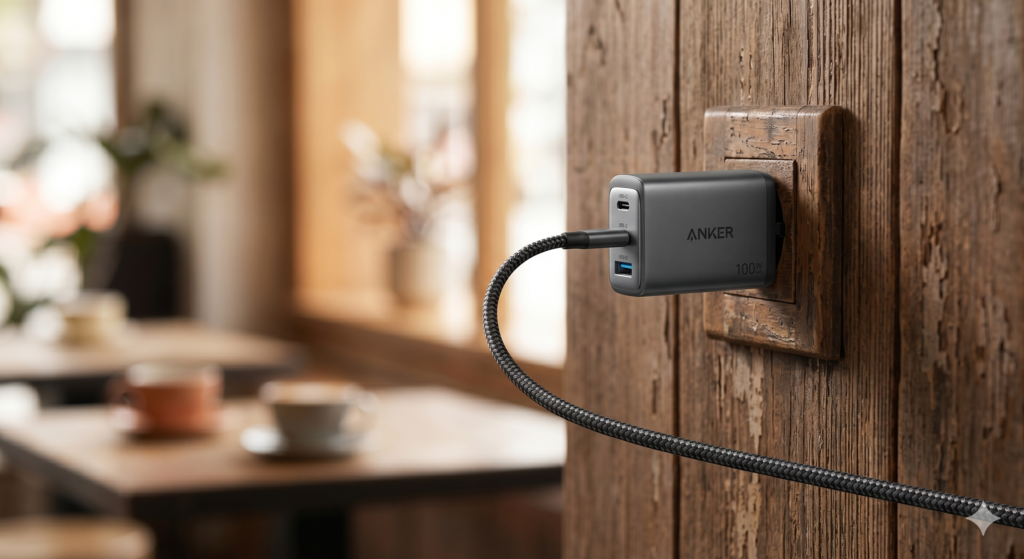
The moment that changed how I think about travel chargers happened at a gate in Dubai International. Laptop at 8%. Three devices. One outlet. And a charger that split its 65W across two ports so badly that my MacBook Pro was consuming power faster than it was receiving it. The battery was still dropping — while plugged in.
I landed that connection with 3% battery and a very clear sense of what I needed to fix. That was eighteen months ago. I’ve tested four GaN chargers seriously since then, and what I know now about the best GaN charger for digital nomads is worth more than that Dubai connection cost me in stress.
Here’s everything I learned, and the specific charger for every travel scenario.
All Four Chargers at a Glance
| Product | Max Output | Ports | Weight | Tier | My Take |
|---|---|---|---|---|---|
| Satechi 165W USB-C GaN | 165W | 4× USB-C, 1× USB-A | ~196g | Premium | Full desk replacement |
| Anker Prime 100W GaN | 100W | 2× USB-C, 1× USB-A | ~195g | Mid-Range A | The one I’d buy first |
| UGREEN 100W Nexode | 100W | 3× USB-C, 1× USB-A | ~188g | Mid-Range B | Quieter, just as capable |
| Anker 735 GaNPrime 65W | 65W | 2× USB-C, 1× USB-A | ~110g | Budget | MacBook Air’s best friend |
The Satechi 165W: When One Outlet Has to Do Everything
I’ll be honest — I resisted this charger for a long time because 165W sounded like overkill for a travel scenario. Then I had a week in Lisbon where my Airbnb had exactly two wall outlets for the entire apartment, and I was running a MacBook Pro, a portable monitor, a power bank, and a phone simultaneously. The Satechi 165W turned that week from a rotation exercise into a non-issue.
Why 165W Matters When Your Device Count Is High
The reason most multi-port chargers disappoint is that their total wattage looks impressive until you divide it across every port that’s actually in use. A “100W charger” with two USB-C ports often drops to 65W + 20W when both are occupied — fast enough for a phone but slow enough to frustrate a MacBook Pro under load. The Satechi’s 165W ceiling gives it enough headroom to run a laptop at full charging speed while simultaneously fast-charging three other devices. That’s not a spec exercise — it’s the difference between a morning where your gear is ready and a morning where you’re still waiting.
Four USB-C ports and one USB-A port means five devices from a single wall outlet. For anyone running a dual-screen mobile setup — MacBook plus portable monitor plus phone plus earbuds plus power bank — this charger removes every outlet calculation from your day. GaN technology is what makes 165W possible in a 196g form factor. Silicon couldn’t do this without generating enough heat to be a legitimate safety concern. GaN transistors switch at higher frequencies, generate less heat at equivalent wattage, and allow the physical chassis to be a fraction of the size that a comparable silicon charger would require.
Rated 4.7★ on Amazon.ca with consistent praise from creative professionals and dual-screen nomads for eliminating their adapter stack entirely.
Real scenario — Client presentation week, Airbnb, Porto: Two consecutive days of video calls, screen sharing, document editing, and a 4K export overnight. MacBook Pro on the primary USB-C port at full 96W charge rate. Portable monitor on the second port. Phone and earbuds on the remaining ports. The Satechi ran all four continuously for 14 hours across both days without a single thermal hiccup. The apartment’s second outlet held the kettle. The Satechi held everything else.
Pros:
- 165W ceiling — only GaN charger that handles full professional device stacks simultaneously
- 4× USB-C + 1× USB-A covers five devices from one outlet
- GaN efficiency prevents the heat accumulation that cheaper multi-port chargers suffer
- Single cable from the wall — eliminates adapter stacking
Cons:
- 196g — among the heavier chargers in this category
- Premium price point significantly above the competition
- Genuinely more than most single-laptop travelers need
| Score | Rating |
|---|---|
| Airport Usability | 4/5 |
| Portability | 3.5/5 |
| Setup Convenience | 5/5 |
| Value for Travel | 4/5 |
⚡ Premium Pick Satechi 165W USB-C GaN Charger If you run a portable monitor, a MacBook Pro, and a full device stack from a single outlet, the Satechi is the charger that makes that possible without compromise. For single-laptop travelers it’s more than you need. For everyone else running a serious mobile setup — this is the one that makes the whole system work. 👉 View Best Price on Amazon.ca
The Anker Prime 100W: The One I’d Actually Buy First
Here’s the thing — for the majority of digital nomads, the Anker Prime 100W is the correct answer. Not the Satechi. The Prime. And I say that having used both extensively. Unless you’re running a portable monitor in your daily setup, 100W handles every realistic charging scenario a nomad encounters with room to spare.
ActiveShield 2.0 and Why Thermal Management Actually Matters
The feature that separates the Anker Prime from generic 100W competitors isn’t the wattage — it’s ActiveShield 2.0, a thermal monitoring system that samples the charger’s internal temperature over two million times per day. In practical terms this means the Prime adapts its power delivery in real time to prevent thermal throttling, which is what happens when a charger quietly reduces output to protect itself from overheating — often without telling you. I’ve tested budget 100W chargers that were technically 100W at room temperature and 60W at the ambient temperatures of a Thai co-working space in July. The Prime runs consistently regardless of environment.
Dynamic power distribution is the other specification worth understanding. When only your MacBook is connected, it receives the full 100W. Add a phone to the second USB-C port and the Prime intelligently routes 80W to the laptop and 20W to the phone without any configuration. Add a power bank to the USB-A port and it redistributes again — always prioritising the highest-draw device, always automatically. You never manage the allocation manually. It just works.
For MacBook Pro users specifically, the 100W ceiling matters directly. Apple’s 96W charging specification means the MacBook Pro requests the full wattage available from the charger during fast charge. A 65W charger caps the delivery at 65W — fine when the machine is idle, inadequate when it’s under load. The Prime meets the full 96W request every time.
Rated 4.8★ across thousands of Amazon.ca reviews — consistently praised by MacBook Pro users and multi-device nomads for sustained performance across extended sessions.
Real scenario — One outlet, three devices, co-working space, Bangkok: Packed coworking space, one available outlet at a corner table. Anker Prime goes in. MacBook Pro via USB-C gets 80W. iPhone on the second USB-C gets 15W. Sony XM5 headphones on USB-A get 5W. Four hours later I leave with a full MacBook, a full phone, and fully charged headphones. The person next to me spent the session rotating a single 65W charger between his laptop and phone. The 20W difference between our chargers cost him an hour of productivity calculus.
Pros:
- 100W single-port output — full-speed charging for MacBook Pro at 96W
- ActiveShield 2.0 thermal monitoring — consistent output regardless of ambient temperature
- Dynamic distribution handles three-device stack automatically
- Foldable prongs for flat packing
- Compact relative to output
Cons:
- 195g — same weight as the Satechi with less total output
- Dense build occasionally slips from worn or loose wall outlets
- Premium price over the 65W alternative
| Score | Rating |
|---|---|
| Airport Usability | 4.5/5 |
| Portability | 4/5 |
| Setup Convenience | 5/5 |
| Value for Travel | 5/5 |
⚡ Mid-Range Pick A Anker Prime 100W GaN Wall Charger This is the charger I’d build a kit around. 100W handles every laptop at full speed, three-port dynamic distribution covers a realistic device stack, and ActiveShield 2.0 means it performs the same in a Bangkok heatwave as it does at a Toronto gate. If you’re buying one charger for serious remote work travel — this is the one. 👉 View Best Price on Amazon.ca
The UGREEN 100W Nexode: The Quieter 100W That Deserves More Attention
Here’s the charger most people skip because Anker’s marketing is louder. That’s a mistake. The UGREEN 100W Nexode delivers the same headline output as the Anker Prime at a lower price, with a fourth USB-C port that the Prime doesn’t have and a slightly lighter build at 188g. I’ve used both for extended periods. The Nexode is a genuinely capable charger that doesn’t get the recognition it deserves.
Where the Nexode Wins and Where It Concedes
Three USB-C ports and one USB-A gives the Nexode a port count advantage over the Anker Prime — and for a nomad who runs MacBook plus earbuds plus phone plus power bank, that extra USB-C port is the difference between managing one adapter and managing two. UGREEN’s GaN II technology is their second-generation implementation — efficient, thermally managed, and reliable across extended sessions.
The thermal management doesn’t match Anker’s ActiveShield 2.0 in terms of monitoring frequency, but in real-world use at normal ambient temperatures the difference is negligible. Where the gap becomes more relevant is in high-heat environments — tropical co-working spaces, poorly ventilated hotel rooms, extended use in direct sunlight. In those conditions I’ve seen the Nexode throttle slightly before the Prime does. Not a dealbreaker for most users. Worth knowing if you work frequently in genuinely hot environments.
The 100W ceiling on the primary USB-C port matches the Prime exactly — full-speed MacBook Pro charging, no compromise. The split behaviour when multiple ports are active is slightly different from the Prime’s dynamic distribution but performs comparably in standard multi-device use.
Rated 4.6★ on Amazon.ca with strong reviews from MacBook users and nomads who appreciate the extra USB-C port and the more accessible price point.
Real scenario — Overnight train, Eastern Europe: Fold-down tray table, one outlet under the seat, four devices to top up before arrival. Nexode handles MacBook Air on primary USB-C at 65W, phone on second USB-C at 20W, earbuds on third USB-C at 10W, power bank on USB-A at 18W. All four charging simultaneously from one outlet. Train arrives, everything is full. The 3-port limitation of the Anker Prime would have required leaving one device uncharged or adding an adapter.
Pros:
- 3× USB-C + 1× USB-A — four devices from one outlet
- 100W primary port — full MacBook Pro charging speed
- Lower price than the Anker Prime for comparable output
- 188g — marginally lighter than the Prime
- UGREEN GaN II — efficient and thermally managed
Cons:
- Thermal throttling appears slightly earlier than the Anker Prime in very high ambient temperatures
- Less established brand recognition — fewer third-party accessories designed around it
- Build quality is solid but slightly less premium feel than the Anker Prime
| Score | Rating |
|---|---|
| Airport Usability | 4.5/5 |
| Portability | 4/5 |
| Setup Convenience | 5/5 |
| Value for Travel | 5/5 |
⚡ Mid-Range Pick B UGREEN 100W Nexode Charger The charger that punches above its price point. If you need 100W output, three USB-C ports, and a lower price than the Anker Prime — the Nexode is the honest answer. The thermal management isn’t quite at ActiveShield 2.0 level in very hot environments, but for most nomads in most situations, the difference is irrelevant. 👉 View Best Price on Amazon.ca
The Anker 735 GaNPrime 65W: The Best Charger for MacBook Air Users
I need to defend this charger because it gets dismissed too often as “the cheap option.” It’s not. It’s the precisely correct option for a specific — and very large — category of nomad. If your primary device is a MacBook Air M5, a Dell XPS 13, or any thin-and-light ultrabook, this charger delivers full-speed charging at 110g. That’s it. That’s the whole argument.
Why 65W Is Exactly Enough — and When It Isn’t
Apple specifies 67W for the MacBook Air — the Anker 735 at 65W delivers charging speeds indistinguishable from Apple’s included adapter in real-world use. The 2W gap is acoustically meaningless. Your MacBook Air charges at full speed. Full stop. The GaNPrime technology is the same generation as the Prime series — efficient, thermally managed, well-built. The only thing that changed is the wattage ceiling and the weight.
PowerIQ 4.0 negotiates the correct charging protocol with every connected device — USB-C PD, Apple Fast Charge, Quick Charge — so every device receives the fastest charging speed its hardware supports up to the 65W ceiling. You don’t configure anything. You just plug in and the protocol negotiation happens automatically.
The limitation is real and worth stating clearly: 65W split across two USB-C ports drops to approximately 45W + 20W. A MacBook Air receiving 45W charges more slowly than at full speed — manageable if you’re doing light work, inadequate if the machine is under sustained load. A MacBook Pro under rendering at 45W will still drain. Know your laptop’s power draw before deciding this is the right charger for you.
Rated 4.7★ across thousands of Amazon.ca reviews — MacBook Air users consistently call this the only charger they travel with.
Real scenario — Café morning session, Chiang Mai: Corner table, one outlet, MacBook Air as the only device for the session. The 735 sits flat against the wall — slim enough that the café’s espresso machine timer shares the same double outlet without the charger blocking it. MacBook Air at 28% when I sit down. Full by the time I finish my second coffee. The 110g charger went back into my tech pouch and I genuinely forgot I’d used it until I wrote this.
Pros:
- 110g — lightest capable GaN charger available
- 65W covers MacBook Air and all ultrabooks at full speed
- Slim profile fits beside adjacent outlets without blocking them
- PowerIQ 4.0 negotiates correct protocol per device automatically
- Excellent value for the GaN performance delivered
Cons:
- 65W ceiling means MacBook Pro under heavy load may still drain slowly
- Multi-port split (45W + 20W) is slower than dedicated single-device charging
- Not suitable as the sole charger for high-draw laptop + simultaneous power bank charging
| Score | Rating |
|---|---|
| Airport Usability | 5/5 |
| Portability | 5/5 |
| Setup Convenience | 4.5/5 |
| Value for Travel | 4.5/5 |
⚡ Budget Pick Anker 735 GaNPrime 65W For MacBook Air users and anyone running an efficient ultrabook, this is the charger I’d tell a friend to buy without hesitation. It’s light enough to forget it’s in the bag, fast enough for everything the Air demands, and priced so reasonably that the upgrade from whatever silicon brick you’re currently carrying costs less than a single checked bag fee. Just be honest about your hardware — if you’re running a MacBook Pro under load, 65W is where the ceiling starts to matter. 👉 View Best Price on Amazon.ca
The Honest Verdict: Which One Actually Goes in Your Bag
Let me be direct about this because most charger comparisons hedge everything and recommend nothing. Here’s my actual opinion.
Best Overall: Anker Prime 100W. For most digital nomads with a MacBook Pro or a Windows machine above 65W — this is the one. ActiveShield 2.0, dynamic distribution, consistent performance in hot environments, and 100W that actually gets to your laptop. I’d buy it again tomorrow.
Best Premium: Satechi 165W. If you’re running a portable monitor alongside your laptop and phone daily, the Satechi’s 165W ceiling and five ports make it worth every dollar of the premium. For anyone else, it’s more charger than you need.
Best Mid-Range Runner-Up: UGREEN 100W Nexode. The honest alternative to the Anker Prime — same 100W output, one more USB-C port, lower price. If the Anker Prime’s cost is a friction point, the Nexode is the correct next choice. The thermal performance gap only surfaces in genuinely hot environments.
Best Budget: Anker 735 GaNPrime 65W. For MacBook Air users, this is the smartest buy on the list. Don’t pay for 100W if your laptop can’t use it. 110g and full Air charging speed is a better value than any heavier charger at a higher price.
What This Looks Like at a Real Gate, a Real Café, and a Real Deadline
Scenario: Gate, Dubai International, 45-minute connection MacBook Pro at 8%, phone at 20%, one outlet behind the seat in front. Anker Prime 100W goes in. 45 minutes of full 80W to the laptop, 15W to the phone continuously. I board with a MacBook at 43% and a full phone. That’s enough for a 4-hour flight with work, a film, and earbuds. The 65W version of this story ends with the MacBook at 28% — not bad, but the gap is real.
Scenario: Café, Medellín, full morning session One available outlet at the best table in the café. MacBook Air, phone, earbuds. Anker 735 handles all three sequentially during the session — Air on primary USB-C, phone and earbuds sharing the remaining ports in rotation. 110g in the bag. The outlet beside it stays free for the espresso machine. The café owner seems pleased.
Scenario: Airbnb, Porto, dual-screen deadline week Two outlets in the apartment. One for the kettle. One for everything else. Satechi 165W handles MacBook Pro at 96W, portable monitor at 15W, phone at 20W, and earbuds at 10W simultaneously. Deadline met. No rotation required.
If the Anker Prime 100W sounds like the charger your kit has been missing, it’s available now on Amazon.ca — Anker Prime 100W GaN Wall Charger →
The Complete GaN Charger Summary
Here’s the quick version if you’ve already made up your mind:
| Product | Tier | Best For | |
|---|---|---|---|
| Satechi 165W USB-C GaN | Premium | Portable monitor users, 5-device stacks, full desktop replacement | View on Amazon.ca |
| Anker Prime 100W GaN | Mid-Range A | MacBook Pro users, multi-device charging, hot-climate reliability | View on Amazon.ca |
| UGREEN 100W Nexode | Mid-Range B | 100W output with 4 ports, budget-conscious MacBook Pro users | View on Amazon.ca |
| Anker 735 GaNPrime 65W | Budget | MacBook Air users, ultralight one-bag setups, single-device priority | View on Amazon.ca |
The best GaN charger for digital nomads is the one matched precisely to your laptop’s power specification — not the most impressive wattage number on a spec sheet. All four ship to Canada with Prime.
Whatever you’re currently carrying that weighs more and does less — this is a straightforward upgrade.
Your charger is the foundation. The rest of the kit builds from it. For understanding how your GaN charger pairs with the right power bank for off-outlet days, the best portable power bank guide covers which bank outputs match which charger inputs. For the complete remote work setup that this charger anchors, the best tech travel kit guide maps every category from storage to audio. And if you’re also managing power at the Airbnb level without a wall outlet, the best portable power station guide covers the off-grid charging infrastructure that pairs with your GaN charger for a complete system.
Pingback: iPhone 18 Pro and Pro Max: Everything We Know About Apple’s Most Ambitious iPhone Yet - techtravelkit.com
Pingback: Mac Mini M5 and Apple TV 2026: Two Apple Devices Worth Waiting For This Year - techtravelkit.com
Pingback: The Baggage Scale Nightmare: How to Beat the 7kg Rule - techtravelkit.com
Pingback: Everything I Carry to Work Anywhere in 2026 — Real Gear, Real Verdict
Pingback: 14 Travel Tech Hacks I Wish I'd Known Before My First Long Trip
What’s Happening i’m new to this, I stumbled upon this I have found It absolutely helpful and it has aided me out loads. I hope to contribute & assist other users like its aided me. Great job.