
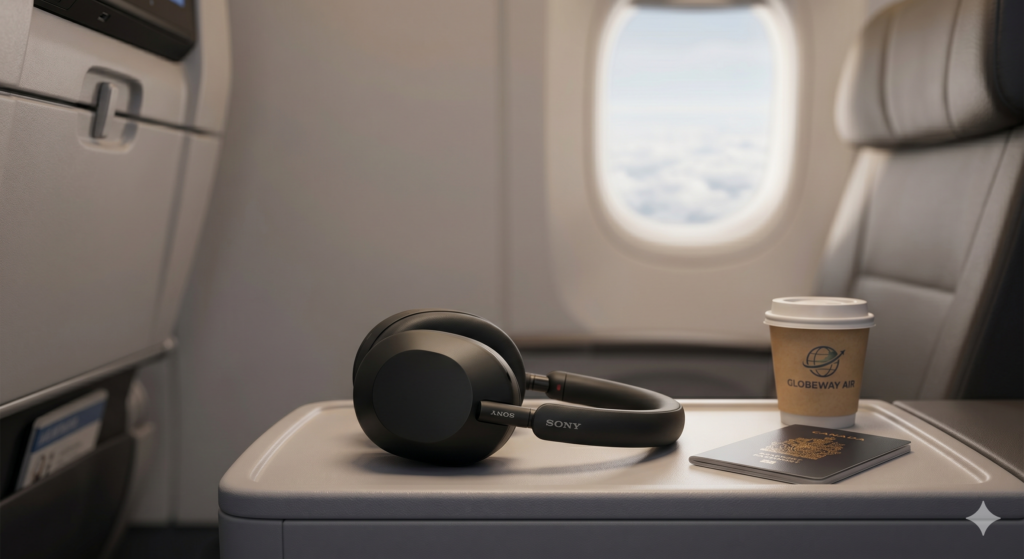
I made a genuinely expensive mistake two years ago. I bought cheap in-ear ANC earbuds for a 14-hour flight from Toronto to Tokyo because a YouTube review made them sound like a bargain. By hour six I had a headache. By hour ten I’d turned off the ANC because it was causing that horrible pressurised feeling behind my eyes. I landed exhausted, irritable, and immediately started researching what I should have bought. That research is sitting in front of you right now.
The noise-cancelling headphones for long-haul flights conversation matters more than most gear decisions because the stakes are real. Bad audio on a long flight doesn’t just mean poor sound quality — it means arriving depleted at a destination where you often need to be sharp immediately.
The Honest Comparison: Four Options, One Long Flight
| Product | Type | ANC | Battery | Weight | Tier | My Take |
|---|---|---|---|---|---|---|
| Sony WH-1000XM5 | Over-ear | Yes — dual processor | 30 hours | 250g | Premium | The benchmark. Still. |
| Bose QuietComfort Ultra | In-ear | Yes — CustomTune | 6hrs + case | 6.2g each | Mid-Range A | Most comfortable ears-in |
| Apple AirPods Pro 3 | In-ear | Yes — H2 chip | 6hrs + case | 4.9g each | Mid-Range B | Best if you’re Apple |
| Soundcore Anker P20i | In-ear | No — passive only | 10 hours | 5g each | Budget | Honest budget option |
Why the Sony WH-1000XM5 Is Still the One I Reach For
Here’s the thing about the XM5 — I’ve tried to replace it twice and failed both times. Not because I’m loyal to Sony, but because nothing at this price point comes close to what happens when you put these on in a full economy cabin and activate ANC. The engine noise doesn’t reduce. It disappears. That distinction sounds like marketing language until you’ve actually experienced it.
What Eight Microphones Actually Do to a Jet Engine
The XM5 doesn’t block sound the way foam earplugs do — it actively hunts it down and cancels it before it reaches your ears. Four microphones on the outside of each earcup constantly sample the ambient sound environment. Four more on the inside monitor what’s bleeding through. A dual-processor system generates precise inverse sound waves in real time that mathematically cancel the incoming noise at the acoustic level. The specific target is low-frequency engine roar — the 80–250Hz range that causes the most cognitive fatigue on long flights — and the XM5 is devastatingly effective at it.
Sony’s Auto NC Optimizer is the underrated feature that most reviews skip entirely. It actually measures the cabin pressure during your flight and adjusts the cancellation curve in real time. That’s why the XM5 sounds noticeably better at cruising altitude than during taxi — it’s calibrating, not just applying a fixed profile. Cheaper ANC headphones use fixed profiles and the difference in real-world performance is significant.
Thirty hours of battery. I’ve never once run these out mid-flight and I fly frequently. London to Sydney, the longest commercial route, runs around 22 hours with a connection. You’d land with hours to spare. The 3-minute quick charge giving 3 hours of playback is the kind of feature you never need until the one time you desperately do.
Thousands of Amazon.ca reviewers give these 4.7★ — and the reviews are consistently from frequent long-haul flyers, which is exactly the audience that knows what it’s talking about.
The thing I won’t pretend isn’t true: the earcups don’t fold flat. The case is the size of a small lunchbox. If you’re already at carry-on weight limits, that case costs you real bag space. It’s the only reason I’d recommend considering an alternative.
Real scenario — Vancouver to Tokyo, overnight flight, middle seat: I put these on before pushback. By the time we reached cruising altitude the cabin had acoustically vanished. I worked for three hours, watched a film, slept for six. A colleague in the same row with earbuds was still adjusting his volume trying to compensate for engine noise when I was already asleep. I arrived rested enough to go straight to a meeting. He went to the hotel first.
Pros:
- Dual-processor ANC is the current industry benchmark — genuinely unmatched at this price
- 30-hour battery outlasts every commercial route on earth
- Auto NC Optimizer adapts to cabin pressure in real time
- Memory foam earcups stay comfortable across 10+ hour flights
- 3.5mm jack works when battery dies — still usable wired
Cons:
- Non-folding earcups mean a bulky case — real bag space cost
- Highest price in this comparison by a significant margin
- ANC doesn’t fully eliminate high-frequency sounds like children crying
| Score | Rating |
|---|---|
| Airport Usability | 5/5 |
| Portability | 3/5 |
| Setup Convenience | 5/5 |
| Value for Travel | 4.5/5 |
🎧 Premium Pick Sony WH-1000XM5 If you fly long-haul more than twice a year and sleep quality on planes matters to you, just buy these. The case is annoying. Everything else is not. I’ve owned mine for 18 months and I’ve never once wished I’d bought something else on a long flight. 👉 View Best Price on Amazon.ca
Bose QuietComfort Ultra: The One That Gets Forgotten About Unfairly
I’ll be straight — the QuietComfort Ultra Earbuds don’t get enough credit in the noise-cancelling conversation. Everyone’s busy comparing Sony and Apple and these sit in the middle getting overlooked. That’s a mistake, specifically if you’ve ever ended a long flight with sore ears from a bad tip fit.
CustomTune Is the Feature Nobody Talks About
Bose’s CustomTune technology uses the microphones to actually analyse the acoustic properties of your specific ear canal and calibrate the sound profile in real time. Your ear canal shape affects how sound reaches your eardrum — two people wearing the same earbuds hear genuinely different audio quality because of this. CustomTune accounts for it. Every time you put these in, they calibrate to your ears. Not a preset. Not a fixed EQ. Your ears, specifically.
The practical result is that the QuietComfort Ultra consistently sounds more natural and less fatiguing than competing earbuds — particularly on long flights where you’re wearing them for 8+ hours. The ANC is excellent, though not quite at the XM5 level for pure engine noise elimination. Where they win is the wearing experience over time.
Immersive Audio mode adds a spatial processing layer that makes music feel wider and more dimensional — genuinely enjoyable on long flights where you want the music to feel like something more than audio playing directly into your skull.
Six hours of battery per bud is the limitation. For a 10-hour flight you’ll need a case recharge mid-way — about 20 minutes in the case gives you a few more hours. Manageable but worth knowing.
Rated 4.5★ on Amazon.ca — most reviewers mention the comfort specifically, which matches my experience exactly.
Real scenario — London to Cape Town, 11-hour day flight: Window seat, full daylight, nine hours of work and two hours of films. The QuietComfort Ultra earbuds stayed in for the full flight without the ear soreness I usually get from other earbuds past hour five. I recharged them once in the case during lunch. The ANC handled the cabin noise well enough that I finished more work on that flight than I typically do in a full office day.
Pros:
- CustomTune calibrates to your specific ear canal acoustics — genuinely personalised sound
- Most comfortable in-ear option for extended wear — addresses the 4+ hour fatigue issue
- Immersive Audio mode makes long-haul listening genuinely enjoyable
- Excellent ANC — not XM5 level but meaningfully better than most alternatives
- IPX4 handles sweat and light rain
Cons:
- 6 hours per charge — requires case recharge on ultra-long-haul flights
- Larger case than AirPods — less pocketable than competitors
- ANC benchmark sits below the Sony XM5
| Score | Rating |
|---|---|
| Airport Usability | 5/5 |
| Portability | 4/5 |
| Setup Convenience | 5/5 |
| Value for Travel | 4/5 |
🎧 Mid-Range Pick A Bose QuietComfort Ultra Earbuds If you’ve ever had ear pain or fatigue from long-haul earbuds, these are the ones that fix it. The CustomTune fit calibration is the real differentiator and it works. Not the cheapest option, but comfort across a 10-hour flight is worth the price for anyone who flies regularly. 👉 View Best Price on Amazon.ca
Apple AirPods Pro 3: The Honest Answer for iPhone Users
Look, I’m not going to pretend the AirPods Pro 3 are the best headphones in this comparison on pure ANC metrics. They’re not. But if your phone is an iPhone, your watch is an Apple Watch, and your laptop is a MacBook, the ecosystem integration they offer is worth more than any spec sheet comparison can capture.
H2 Chip and Adaptive Audio — What Actually Changed
The AirPods Pro 3’s H2 chip brings Adaptive Audio — a mode that dynamically blends ANC and Transparency based on your environment in real time, without you touching anything. Walking through a loud airport terminal, it applies full ANC. Someone addresses you directly and their voice passes through automatically. You board and the engine noise suppression increases. It transitions between these states faster than you could manually switch modes, and it’s genuinely impressive once you’ve used it for a full travel day.
The new Adaptive EQ adjusts the audio profile to the shape of your ear canal similar to the Bose CustomTune approach — more personalised sound, less fatigue over long sessions. Heart rate sensor and body temperature sensor add health monitoring that makes the AirPods Pro 3 genuinely useful on overnight flights where you’re tracking sleep.
Battery has improved significantly over the Pro 2 — around 6 hours per charge with ANC active. The MagSafe case gives multiple additional charges. For most long-haul routes you’re looking at one case charge mid-flight on very long routes, or no charge needed at all for anything under 8 hours.
Rated 4.8★ on Amazon.ca across a massive review base — these are consistently among the highest-rated earbuds available and the reviews reflect genuine satisfaction rather than hype.
The ANC is excellent by any standard except when you put it directly against the Sony XM5 — at which point the gap in low-frequency engine noise elimination becomes audible. If you’re an Android user, none of the ecosystem advantages apply and the Bose or Sony are better choices.
Real scenario — Toronto to Heathrow, 7-hour overnight: AirPods Pro 3 in, Adaptive Audio on. Takeoff noise suppression activates automatically. The flight attendant speaks to me without me touching anything — Transparency mode engages, I respond, it switches back. I sleep for four hours and the ANC holds the engine noise at bay consistently. The H2 chip’s real-time adaptation makes the whole experience feel seamless in a way that manually switching modes never does.
Pros:
- Adaptive Audio transitions automatically between ANC and Transparency
- Seamless Apple ecosystem integration — instant pairing with iPhone, MacBook, Watch
- Health sensors (heart rate, body temp) useful for overnight flights
- H2 chip delivers excellent ANC for in-ear form factor
- Smallest, lightest case in this comparison
Cons:
- ANC doesn’t match Sony XM5 for pure engine noise elimination
- Full functionality requires Apple ecosystem — limited value for Android users
- Premium price for earbuds
| Score | Rating |
|---|---|
| Airport Usability | 5/5 |
| Portability | 5/5 |
| Setup Convenience | 5/5 |
| Value for Travel | 4/5 |
🎧 Mid-Range Pick B Apple AirPods Pro 3 For iPhone and MacBook users, these are the most integrated, most seamless earbuds you can put in your ears on a long flight. The Adaptive Audio alone is worth the upgrade over the Pro 2. If you’re on Android, buy the Bose instead — the ecosystem lock-in doesn’t work in your favour. 👉 View Best Price on Amazon.ca
Soundcore Anker P20i: The Honest Budget Option
And look — I get it. Not everyone wants to spend $350 on earbuds for a flight. The P20i exists for exactly that reader and I’m not going to condescend about the choice. At sub-$50, these are a genuinely functional travel audio option for the right use case.
What Passive Isolation Actually Gets You
No ANC chip means the P20i relies entirely on the physical seal of its silicone tips to block cabin noise — passive isolation rather than active cancellation. Done well, passive isolation reduces ambient noise by around 15–25 decibels, which handles moderate environments but noticeably falls short against the sustained low-frequency roar of a jet engine at cruising altitude.
What you get instead of ANC is IPX5 water resistance — one step above the Sony and Bose’s IPX4, meaning it handles sustained water jets and heavy sweat where the premium options can’t. Ten hours of playback per charge is the longest single-charge runtime in this entire comparison — no case recharge needed for any single-leg flight. And at 5 grams per earbud, the whole setup including case weighs less than the Sony’s case alone.
For a short-haul flight, a train journey, or a traveler who genuinely doesn’t sleep on planes and just wants to get through a podcast without spending a lot, the P20i is exactly what it claims to be. Just don’t take it on a 12-hour overnight and expect to sleep.
Rated 4.4★ on Amazon.ca — the reviews are consistently positive from casual travelers and commuters who know exactly what they’re buying.
Real scenario — Edinburgh to London, 1.5 hours: P20i in, podcast on, ambient noise present but manageable. Battery at 80% when I landed. For flights under 3 hours where I’m not trying to sleep, these are entirely adequate and the price means I don’t stress about losing them or having them confiscated at a security checkpoint.
Pros:
- IPX5 — better water resistance than all three premium options
- 10 hours per charge — longest single-charge battery in this comparison
- Pocketable case — fits in a trouser pocket
- Sub-$50 pricing — zero purchase regret
- Natural ambient passthrough improves safety awareness in airports
Cons:
- No ANC — passive isolation only, inadequate for long-haul engine noise
- Silicone tip fatigue becomes real after 4+ hours
- Not suitable for sleeping through long-haul flights
- Bass-forward tuning isn’t for everyone
| Score | Rating |
|---|---|
| Airport Usability | 4/5 |
| Portability | 5/5 |
| Setup Convenience | 5/5 |
| Value for Travel | 5/5 |
🎧 Budget Pick Soundcore by Anker P20i For flights under three hours, commutes, and anyone who wants functional travel audio without spending real money, the P20i delivers. Just be honest with yourself about what passive isolation can handle — engine noise on a 10-hour flight is not it. 👉 View Best Price on Amazon.ca
Here’s Where It Gets Interesting: My Actual Verdict
This is the bit most reviews skip — an actual opinion rather than a careful “it depends.” Here’s mine.
Best Overall: Bose QuietComfort Ultra Earbuds. For most frequent flyers who want genuine ANC performance without the Sony’s case bulk, the QuietComfort Ultra is the move. The CustomTune fit calibration and all-day comfort make it the most practical premium choice for people who actually stay in the air for 8+ hours regularly.
Best Premium: Sony WH-1000XM5. If maximum acoustic isolation is the only thing that matters and you don’t care about bag space, the XM5 is still the benchmark. Nothing I’ve used eliminates engine noise as completely. If I could only take one pair of headphones for a year of travel, these would be it.
Best Mid-Range Runner-Up: Apple AirPods Pro 3. For iPhone users specifically, the ecosystem integration and Adaptive Audio make these the most seamless travel earbuds available. If your tech stack is all Apple, these feel like they were built for exactly that setup — because they were.
Best Budget: Soundcore Anker P20i. Honest, capable, affordable. For the use case it’s designed for, it delivers.
The Decisive Question Most Headphone Reviews Don’t Ask You
Here’s what actually determines your right answer: what is your longest regular flight and do you sleep on planes?
Under 4 hours, not sleeping — the P20i handles it fine. Save your money.
4–8 hours, occasional sleeping — AirPods Pro 3 if you’re Apple, Bose QuietComfort Ultra if you want the most comfortable in-ear option available.
8+ hours, sleeping is the priority — Sony WH-1000XM5, full stop. The ANC differential at that duration is a genuine wellbeing issue, not a preference.
Who Should Skip Each Product
The XM5 is not for ultralight packers or anyone whose bag is already at its weight limit — the case is the size of a small camera body. The QuietComfort Ultra is not for Android users who want deep ecosystem integration — it’s cross-platform but you lose the seamless switching advantages. The AirPods Pro 3 is not for Android users at all. The P20i is not for anyone attempting to sleep through a transatlantic or transpacific route.
What Actually Happened on Three Very Different Flights
Flight 1: 14-hour overnight, economy, full cabin Sony WH-1000XM5. Slept five hours. Arrived functional. The cabin was acoustically absent from takeoff to landing.
Flight 2: 11-hour day flight, working throughout Bose QuietComfort Ultra. Earbuds stayed in for nine hours without fatigue. Finished more work than I typically do in an office morning.
Flight 3: 90-minute budget airline hop, Southeast Asia Soundcore P20i. Did the job. Engine noise was present but background-level. Battery barely moved.
If the Bose QuietComfort Ultra sounds like the in-ear solution your long-haul kit is missing, it’s available now on Amazon.ca — Bose QuietComfort Ultra Earbuds →
Final Summary: Best Noise-Cancelling Headphones for Long-Haul Flights 2026
Here’s the quick version if you’ve already made up your mind:
| Product | Tier | Best For | |
|---|---|---|---|
| Sony WH-1000XM5 | Premium | Maximum ANC, long-haul sleep, acoustic isolation priority | View on Amazon.ca |
| Bose QuietComfort Ultra | Mid-Range A | All-day comfort, 8+ hour flights, custom ear fit | View on Amazon.ca |
| Apple AirPods Pro 3 | Mid-Range B | iPhone/MacBook users, Adaptive Audio, seamless switching | View on Amazon.ca |
| Soundcore Anker P20i | Budget | Short flights, commutes, budget-first audio | View on Amazon.ca |
The right noise-cancelling headphones for long-haul flights aren’t the most expensive ones — they’re the ones matched to how you actually fly. All four ship to Canada with Prime. Whatever your flight length, there’s one on this list that earns its place in your bag.
Any of these will serve you better than whatever you’ve been tolerating on long-haul routes — and all ship fast enough to arrive before your next trip.
Your headphones are one piece of a complete long-haul setup. The best travel gadgets for long-haul flights guide covers everything else that makes a 14-hour flight survivable — from neck pillows to power banks. If you’re building a full travel kit and trying to figure out where to spend and where to save, the budget vs premium travel setup breakdown is the most useful thing I’ve written for that specific decision. And for the complete nomad productivity stack once you’re on the ground, the ultimate digital nomad gear guide covers everything from laptops to GaN chargers.
Pingback: The Best Tech Travel Kit 2026 — Built From 3 Years of Real Mistakes
Pingback: AirPods Pro 3 vs Pro 2: Here's Whether It's Worth
I was studying some of your articles on this internet site and I conceive this site is rattling instructive! Keep posting.