
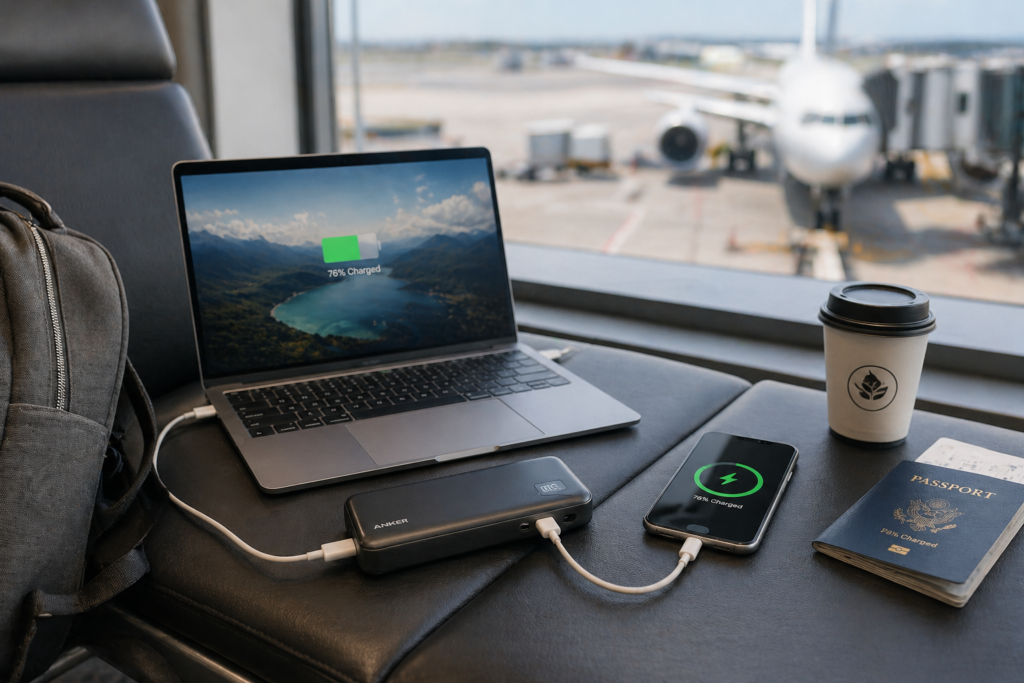
Your phone never dies when it’s convenient. It dies when you need it most—boarding passes, maps, hotel check-ins, or mid-call. That’s exactly why why every traveler needs a portable power bank isn’t optional anymore—it’s a core part of modern travel.
A reliable power bank doesn’t just charge your devices. It removes your dependency on infrastructure that’s unpredictable at best and unavailable at worst.
Quick Comparison: Best Portable Power Banks for Travel
| Product | Key Specs | Best Use Case | Tier |
|---|---|---|---|
| Anker 737 (PowerCore 24K) | 24,000mAh, 140W USB-C PD, 3 ports | Laptop + multi-device charging | Premium |
| INIU 10,000mAh Slim | 10,000mAh, compact, USB-C | Phone backup | Budget |
🔋 Premium
This is where portable charging stops being a backup and becomes infrastructure. The output is strong enough to charge laptops, the capacity handles full travel days, and the speed actually matters when you only have short charging windows. The trade-off is weight—it’s not pocketable and can feel excessive for light travelers.
👉 View Best Price on Amazon.ca
Why Output Power Matters More Than Battery Size
Most travelers focus on mAh. Experienced travelers focus on wattage.
Here’s the difference in real use:
- Low-output power bank → slow recovery → constant battery anxiety
- High-output power bank → fast recovery → full usability within minutes
That’s what separates a backup device from a reliable power source.
Real-World Scenario: Airport Gate With No Power Access
You finally find a seat—but no outlet.
With a high-output power bank:
- Your phone charges immediately
- Your laptop stays usable
- You don’t move, wait, or compete
Outcome: You stay productive without adjusting your position around power.
Why the Anker 737 Works for Real Travel
High-output charging (140W)
This isn’t just for phones—it handles laptops and tablets without slowing down.
Multi-device support
You can charge:
- Phone
- Earbuds
- Laptop
at the same time without losing efficiency.
To fully utilize that power, pairing it with a proper cable matters:
👉 Anker 100W USB-C Cable
Without a high-capacity cable, you’re limiting output performance.
Pros
- Laptop-capable charging
- Fast recharge speeds
- Multi-device efficiency
Cons
- Heavier than standard options
- Overkill for casual travel
Scores
- Airport Usability: 5/5
- Portability: 4/5
- Setup Convenience: 5/5
🔋 Budget
This is what most travelers actually need—simple, lightweight, and reliable. It won’t power laptops or deliver fast charging, but it keeps your phone alive without adding bulk.
👉 Check Current Price on Amazon.ca
Why Smaller Power Banks Still Matter
Not every trip requires high output.
Where this shines
- City exploration
- Day trips
- Minimalist packing
Real-world scenario
You’re navigating, taking photos, and using data all day.
Instead of stopping early:
→ You keep moving without worrying about battery.
Pros
- Lightweight and compact
- Affordable
- Easy to carry daily
Cons
- Slow charging
- Not suitable for laptops
Scores
- Airport Usability: 4/5
- Portability: 5/5
- Setup Convenience: 5/5
Anker 737 vs INIU: Choosing Based on Travel Style
This isn’t about which is better—it’s about what you carry.
Head-to-head
- Anker 737 → Power, speed, full setup support
- INIU 10K → Simplicity, portability
Best for different travelers
Choose Anker 737 if you:
- Work remotely while traveling
- Carry a laptop
- Need fast charging
Choose INIU if you:
- Travel light
- Only need phone backup
- Want minimal weight
Who These Are NOT For
- Anker 737 → Not for ultra-light packers
- INIU → Not for multi-device or laptop users
Real Travel Scenarios Where Power Banks Save You
✈️ Long-haul flight
Seat outlets are unreliable or slow.
→ Your phone stays alive for entertainment and arrival prep
☕ Café work session
Only one outlet—and it’s taken.
→ Your laptop keeps running without interruption
🚕 Navigation in a new city
Battery drops to 5%.
→ Your trip doesn’t stop
Build a Smarter Travel Tech Setup
A power bank becomes far more effective when it’s part of a complete system—not a standalone gadget.
For international trips, pairing it with a reliable adapter from this top-rated universal adapters guide ensures you can actually recharge your power bank anywhere without compatibility issues.
To avoid tangled cables and wasted time digging through your bag, a structured setup like this minimalist tech kit breakdown keeps everything accessible when you need it most—especially in high-pressure moments like boarding or security.
And if you want a full, optimized setup that balances portability, performance, and real-world usability, this complete tech travel kit guide shows how everything fits together into a system that actually works while traveling.
Final Verdict: Why Every Traveler Needs a Portable Power Bank
| Product | Tier | Best For | CTA |
|---|---|---|---|
| Anker 737 (PowerCore 24K) | Premium | Laptop + multi-device charging | View on Amazon.ca |
| INIU 10,000mAh Slim | Budget | Phone charging | View on Amazon.ca |
When considering why every traveler needs a portable power bank, the answer is simple:
👉 It removes dependency.
No more:
- Searching for outlets
- Waiting for charging spots
- Planning around battery life
You move when you want—not when your battery allows.
Pingback: Best Portable Power Station for Remote Work Off the Grid in 2026 - techtravelkit.com
Pingback: The Travel Gadgets I Actually Use on Every Trip — Nothing Paid, All Tested
Pingback: iPhone 18 Pro and Pro Max: Everything We Know About Apple’s Upcoming iPhone - techtravelkit.com
There are certainly a lot of particulars like that to take into consideration. That may be a nice level to deliver up. I provide the ideas above as general inspiration however clearly there are questions just like the one you carry up the place the most important thing will probably be working in sincere good faith. I don?t know if best practices have emerged around things like that, but I am positive that your job is clearly recognized as a fair game. Both boys and girls really feel the impact of just a second’s pleasure, for the rest of their lives.