
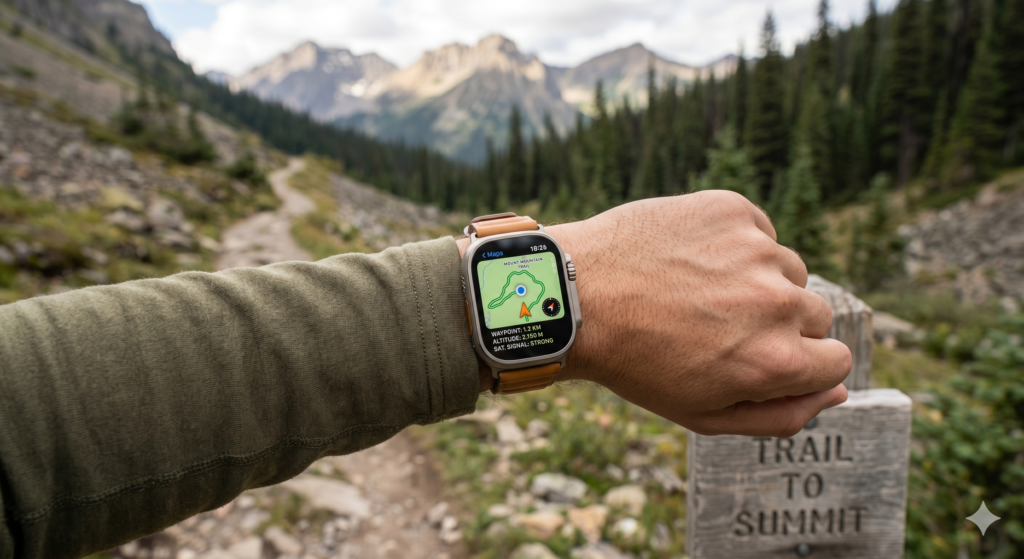
Most smartwatches are designed for the gym and the commute. The best smartwatch for travel has to survive something harder: a week in a remote coastal town with no charging access, a mountain trail without cell signal, and a border crossing where your phone dies but you still need navigation. The gap between a good smartwatch and a great travel smartwatch comes down to three things — GPS reliability, battery life measured in days not hours, and build quality that doesn’t require a padded case.
Two watches define opposite ends of that spectrum in 2026: the Apple Watch Ultra 3 as the premium pick, and the Garmin Instinct 2 Solar as the rugged, battery-first budget alternative.
At a Glance: Premium vs. Budget Travel Smartwatch
| Feature | Apple Watch Ultra 3 | Garmin Instinct 2 Solar |
|---|---|---|
| Battery Life | Up to 72 hours (low power) | Up to 70 days (solar + smartwatch) |
| GPS | L1/L5 dual-frequency | Multi-GNSS (GPS, GLONASS, Galileo) |
| Durability Rating | MIL-STD-810H, 100m water | MIL-STD-810H, 100m water |
| Emergency Feature | Satellite SOS | N/A |
| Connectivity | LTE + WiFi + Bluetooth | Bluetooth + ANT+ |
| Best Use Case | Full smartwatch + emergency safety | Ultra-long battery, outdoor navigation |
| Price Tier | Premium | Budget |
⌚ Premium Pick Apple Watch Ultra 3 The Ultra 3 is the most capable travel smartwatch Apple has ever built — satellite SOS, dual-frequency GPS, and a titanium case that takes genuine punishment. The honest drawback: even with low-power mode, 72 hours of battery means you’re charging every two to three days, which is a real constraint in remote locations without reliable power access. 👉 View Best Price on Amazon.ca
Apple Watch Ultra 3: When Your Watch Needs to Be Your Safety Net
Why Satellite SOS Changes the Risk Equation for Solo Travelers
The Apple Watch Ultra 3’s satellite SOS capability is not a gimmick — it is the feature that makes this watch genuinely different from every other smartwatch on the market for solo travelers. In a situation where your phone has no signal and you need emergency services — a hiking injury, a remote road accident, a medical episode far from a city — the Ultra 3 can connect directly to emergency satellites and transmit your location and distress signal without any cellular infrastructure.
For solo travelers moving through remote destinations — Indonesian islands, Patagonian trekking routes, rural Southeast Asia — this is the first smartwatch that functions as a genuine safety device rather than a fitness tracker with notifications.
Beyond safety, the L1/L5 dual-frequency GPS is meaningfully more accurate than standard GPS. Standard GPS uses a single frequency that reflects off buildings and terrain, causing position drift of 5–10 metres in urban canyons or dense forest. Dual-frequency GPS uses two signals that cancel out atmospheric interference, delivering 1–2 metre accuracy. In navigation terms, that’s the difference between being directed to the correct alley entrance and walking past it twice.
The titanium case handles real-world travel abuse — knocks against doorframes, beach sand, salt water — without the cosmetic damage that softer alloy cases accumulate over months of continuous wear. Rated to MIL-STD-810H and 100 metres water resistance, it’s genuinely built for environments beyond the gym.
Consistently rated 4.8★ across thousands of Amazon.ca reviews, with particular praise from adventure travelers and solo female travelers for the safety features.
Real-World Scenario: Remote Trek, Northern Thailand
You’re three days into a solo trek through a national park in northern Thailand. No cell signal since day one. Your phone battery is at 12% and you’re conserving it for photos. The Ultra 3 has been navigating via offline maps, tracking your elevation and heart rate, and sitting at 38% battery in low-power GPS mode. A wrong turn adds two hours to your route — the watch recalculates without hesitation. You arrive at the guesthouse knowing that if anything had gone wrong on that trail, satellite SOS was one press away.
Pros:
- Satellite SOS — emergency capability without cellular infrastructure
- L1/L5 dual-frequency GPS — best-in-class position accuracy
- Titanium case with MIL-STD-810H rating
- Full Apple ecosystem integration — Wallet, Maps, Translate, Health
- Large display readable in direct sunlight
Cons:
- 72-hour battery ceiling in low-power mode — requires charging every 2–3 days
- Premium price is the highest in the smartwatch category
- Bulkier than standard Apple Watch — noticeable on smaller wrists
| Score | Rating |
|---|---|
| Airport Usability | 5/5 |
| Portability | 4/5 |
| Setup Convenience | 4.5/5 |
| Value for Travel | 4/5 |
Garmin Instinct 2 Solar: The Watch That Outlasts Your Trip
When Battery Life Is the Spec That Matters Most
There is a class of traveler for whom 72-hour battery life is a dealbreaker regardless of every other feature on the spec sheet. If you’re doing multi-week overlanding, island-hopping without reliable electricity, or extended backcountry travel, the Garmin Instinct 2 Solar’s 70-day battery life in smartwatch mode — extended indefinitely with solar charging in good light conditions — removes battery anxiety from your entire trip.
Garmin’s solar charging integration is not a marketing claim — in real-world conditions with regular outdoor exposure, the Instinct 2 Solar can sustain indefinite runtime. The solar lens continuously harvests ambient light and feeds it back into the battery, meaning the more time you spend outdoors (which is the point of travel), the longer the watch lasts.
Multi-GNSS support — GPS, GLONASS, and Galileo simultaneously — provides strong satellite acquisition in environments where a single-constellation watch struggles: dense jungle, deep valleys, high-latitude destinations. The Garmin platform also carries 25 years of navigation DNA, and it shows in the quality and reliability of the routing, waypoint, and map functionality.
Consistently rated 4.7★ on Amazon.ca, with strong reviews from long-haul travelers, ultralight backpackers, and remote workers doing extended off-grid stints.
Real-World Scenario: Island-Hopping, Philippines, Three Weeks
Three weeks, eleven islands, charging infrastructure ranging from unreliable to nonexistent. The Instinct 2 Solar tracked every boat crossing, beach walk, and motorbike route without a single charge from a wall outlet. Solar top-ups during beach days kept the battery above 80% for the entire trip. Navigation, sunrise/sunset times, tide data, and step tracking — all running continuously. You returned home with the same watch battery you left with.
Pros:
- Up to 70-day battery in smartwatch mode — solar extends indefinitely
- Multi-GNSS for strong signal acquisition in challenging terrain
- MIL-STD-810H rated — genuinely rugged build
- Lightweight at ~53g — barely noticeable on the wrist
- No dependence on smartphone ecosystem
Cons:
- No satellite SOS emergency capability
- Monochrome display — no colour maps or rich notifications
- No NFC payments or app ecosystem
- Lacks the polish of Apple Watch for everyday smartwatch tasks
| Score | Rating |
|---|---|
| Airport Usability | 4.5/5 |
| Portability | 5/5 |
| Setup Convenience | 4/5 |
| Value for Travel | 5/5 |
⌚ Budget Pick Garmin Instinct 2 Solar For travelers who prioritise survival over sophistication, the Instinct 2 Solar is the most practical watch you can put on your wrist. The battery life alone justifies the purchase for anyone spending more than a week away from reliable charging. Just know going in that it’s a navigation and fitness tool first — it won’t replace your phone for notifications and payments the way the Ultra 3 does. 👉 View Best Price on Amazon.ca
Ultra 3 vs. Instinct 2 Solar: Choosing Your Travel Priority
The honest comparison comes down to one question: do you need a smartwatch that keeps you safe, or one that keeps running?
The Ultra 3 is the better watch by almost every measure except battery life. Satellite SOS, dual-frequency GPS, Apple ecosystem integration, full-colour display, NFC payments, and a premium build — it does more, connects to more, and protects you more comprehensively. The battery trade-off is real but manageable if you’re traveling through areas with occasional power access.
The Instinct 2 Solar is the better survival tool for extended off-grid travel. Seventy days of battery, solar charging, multi-GNSS navigation, and a case that shrugs off genuine abuse — if you’re gone for weeks rather than days and charging access is uncertain, it’s the watch you want on your wrist.
Best For…
- Solo travelers and safety-conscious nomads: Apple Watch Ultra 3 — satellite SOS is the feature that matters when things go wrong.
- Long-haul overlanders and off-grid travelers: Garmin Instinct 2 Solar — nothing else comes close on battery longevity.
- Apple ecosystem users: Ultra 3 — the integration with iPhone, Maps, and Wallet is seamless in a way Garmin can’t replicate.
- Budget-focused travelers doing extended trips: Instinct 2 Solar delivers 90% of the navigation capability at a fraction of the price.
Who Each Product Is NOT For
The Ultra 3 is not for travelers who spend weeks away from any power source — 72 hours is a hard ceiling that solar cannot extend. The Instinct 2 Solar is not for travelers who rely on their watch for contactless payments, rich notifications, or emergency satellite communication.
Two Scenarios Where the Right Watch Made the Call
Scenario: Solo Hiking Emergency, Corsica
A solo hiker on the GR20 trail in Corsica rolls an ankle on day four, seven kilometres from the nearest road. Phone signal: zero. The Apple Watch Ultra 3’s satellite SOS connects within 90 seconds, transmits GPS coordinates to emergency services, and keeps a live location update running until rescue arrives. Without satellite capability, the nearest help would have been a two-hour limp down a mountain trail.
Scenario: Six-Week Overland Route, Central Asia
Six weeks from Almaty to Tashkent by local transport, guesthouses, and occasional wild camping. Charging access: sporadic at best. The Garmin Instinct 2 Solar ran for the entire trip on two brief USB top-ups and daily solar harvesting during outdoor segments. Every border crossing, mountain pass, and navigation waypoint logged without interruption. The watch outlasted three phone charging cables and one power bank.
If the Apple Watch Ultra 3 sounds like the safety upgrade your travel kit needs, it’s available now on Amazon.ca — Apple Watch Ultra 3 →
Final Summary: Best Smartwatch for Travel in 2026
| Product | Tier | Best For | |
|---|---|---|---|
| Apple Watch Ultra 3 | Premium | Solo travelers, safety-first, Apple ecosystem, remote destinations | View on Amazon.ca |
| Garmin Instinct 2 Solar | Budget | Off-grid travel, extended trips, ultra-long battery, outdoor navigation | View on Amazon.ca |
The best smartwatch for travel is the one matched to your specific risk profile and travel style. If you’re moving through remote destinations solo, the Ultra 3’s satellite SOS capability is worth every dollar of the premium. If you’re gone for weeks and reliability means battery life above all else, the Instinct 2 Solar is the most dependable piece of hardware you can put on your wrist.
Both ship to Canada with Prime — if your next trip is within the month, sorting your wrist tech before you leave is worth the fifteen minutes it takes.
For a complete travel safety and tech setup, the ultimate digital nomad gear guide covers how your watch fits into a full kit built for remote work and extended travel. If power access is a concern on your next trip, the best portable power bank guide covers exactly how to keep your Ultra 3 charged when outlets are scarce. And if you’re building a one-bag setup where weight is everything, the minimalist tech kit maps out how to carry a complete professional travel setup under 7kg.
Pingback: Fitbit Air: Google's $99 WHOOP Killer — Everything Announced Today
Pingback: Used the Galaxy S26 Ultra for 6 Weeks Travel. Honest Verdict
Hiya, I’m really glad I have found this information. Nowadays bloggers publish only about gossips and web and this is actually frustrating. A good web site with interesting content, that’s what I need. Thanks for keeping this web-site, I will be visiting it. Do you do newsletters? Can’t find it.