
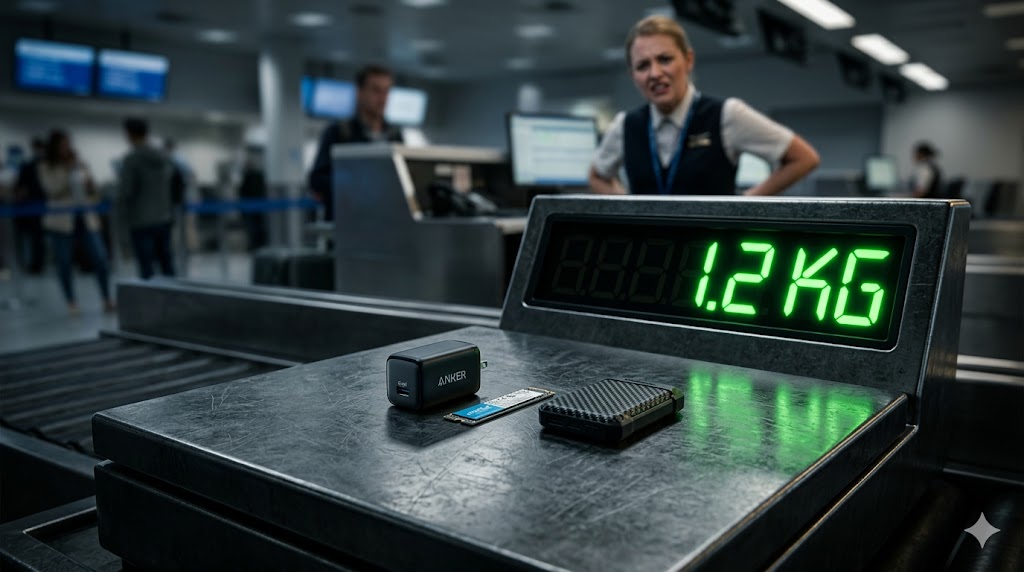
The moment that broke me was a Ryanair gate in Stansted. My bag was 7.3kg. The agent was in no mood for negotiation. I paid £55 to check a bag I’d carried on every flight for the previous four months, and I spent the entire flight doing mental accounting — trying to figure out where 300 grams of unnecessary weight had crept in.
I’ve been obsessive about it ever since. Not because I enjoy the constraint, but because checking a bag introduces a set of downstream problems that every nomad knows: 45-minute waits at carousels, airline damage, the specific anxiety of watching a bag that contains your income disappear down a conveyor belt. The 7kg carry-on limit is a genuine operational problem for digital nomads and the solution is specific, repeatable, and not particularly expensive once you know which items are doing the most weight damage.
This guide is that solution. Not a vague “go ultralight” philosophy — an actual gram-by-gram breakdown of a verified working setup that clears 7kg with margin to spare.
The Weight Budget Framework: How to Think About 7kg
Before products, you need a mental model. A 7kg carry-on limit is a budget, not a hard wall — and like any budget, it requires allocation across categories before you start spending.
Here’s how I think about it:
| Category | Target Weight | Notes |
|---|---|---|
| Bag itself | 800–900g | A quality 20L daypack runs 700–950g |
| Laptop | 1,200–1,600g | MacBook Air M5 is 1,240g |
| Charger | 100–200g | GaN replaces three separate chargers |
| Power bank | 150–220g | Phone-focused, not laptop-focused |
| Audio | 50–80g | Earbuds only — no over-ear case |
| Storage | 40–60g | Slim SSD, not ruggedised brick |
| Adapter | 100–130g | One universal, not multiple country-specific |
| Cables | 80–100g | Two max — USB-C and USB-C |
| Organiser | 100–150g | Flat pouch, not structured case |
| Security | 50g | AirTag 4-pack is 44g total |
| Clothing & personal | 1,200–1,800g | Remaining allocation |
Total tech weight target: approximately 2.2–2.5kg. That leaves 3–3.5kg for your bag, clothing, and personal items — enough for a functional 7–10 day wardrobe in a 20L pack if you’re deliberate about fabric choices.
The failure mode I see repeatedly: nomads optimise their clothing to ultralight merino and then pack a 620g power bank and a 250g laptop charger brick and wonder why they’re overweight. The tech pouch is where most 7kg failures happen — and it’s the easiest category to fix.
The Products That Fill This Budget
The Laptop: Start Here Because It Dominates the Budget
The laptop is the single largest weight item in the kit and the one with the least flexibility — you need what you need for your workload. But within the constraint, the choice matters.
The MacBook Air M5 at 1,240g is the correct answer for any nomad whose work doesn’t require sustained heavy CPU load. That’s the majority of us — writing, calls, coding standard projects, design in Figma, spreadsheets, content management. 1,240g for a laptop that runs 18 hours on a charge, handles everything standard professional work demands, and doesn’t require a cooling fan is the best weight-to-productivity ratio in the laptop category.
For comparison: a MacBook Pro 14″ M5 Pro is 1,620g. A Windows ultrabook in the same performance class typically runs 1,300–1,500g. The Air M5 is the lightest capable professional laptop Apple makes. For a 7kg build, that 380g saving over the Pro is not abstract — it’s the difference between passing and failing a strict gate check.
The Charger: The Category Where Most People Carry 3× What They Need
Here’s the dead weight most nomads don’t think about: the original laptop charger. MacBook chargers weigh 170–220g depending on the wattage. Most people also carry a separate phone charger (another 60–120g) and sometimes a separate adapter for their earbuds or watch (another 40–80g). That’s 270–420g of charging infrastructure before you’ve added a single cable.
The Anker 735 GaNPrime 65W replaces all of it at 110g. Two USB-C ports and one USB-A port handle laptop, phone, and earbuds simultaneously from a single wall outlet. At 65W it charges the MacBook Air at full speed — Apple specifies 67W and the 2W gap is invisible in real-world charging times. GaN technology is what makes 65W possible in 110g — silicon would need three times the volume to handle equivalent heat at equivalent wattage.
The weight saving from switching to the Anker 735 is typically 160–300g depending on what you were carrying before. On a 7kg build that’s enormous — it’s the difference between a 5-day buffer and a 0g buffer at the gate.
Rated 4.7★ on Amazon.ca — consistently praised by MacBook Air users for the slim profile and outlet-sharing capability.
👉 Anker 735 GaNPrime 65W on Amazon.ca
The Power Bank: Right-Size This or It Defeats the Purpose
The most common power bank mistake in a 7kg build is carrying laptop-charging capacity when you only need phone-charging capacity. The Anker 737 PowerCore 24K is an exceptional power bank — and it weighs 620g. For a 7kg carry-on, that’s 8.8% of your entire weight budget on one item.
If you need to charge a laptop away from outlets, there’s no lightweight solution — you’re paying the weight cost for the capability. But if you just need your phone topped up through a long transit day, the INIU 10,000mAh Slim at 204g is the honest right-sized answer. Two and a half iPhone charges. USB-C input and output. Pocketable. 204g. For most transit days that’s all you actually need.
For iPhone users specifically, the Anker 622 Magnetic Battery MagGo at 96g is the specialist option — it snaps to the back of your phone magnetically and provides slow continuous top-up charging throughout the day without any cables. Not a replacement for a proper bank, but as a complement it adds 5,000mAh of capacity at 96g, which is genuinely impressive for the weight.
Rated 4.5★ on Amazon.ca — the INIU consistently praised for the slim form factor and reliable output from casual travelers and commuters.
👉 INIU 10,000mAh Slim on Amazon.ca | Anker 622 MagGo on Amazon.ca
Audio: The 250g Saving Nobody Talks About
A Sony WH-1000XM5 plus its carry case weighs approximately 530g. The case alone is 280g and the size of a small lunchbox. On a 7kg build, those are numbers you cannot afford.
The Soundcore by Anker P20i with its case weighs approximately 55g total. That’s a 475g saving over the XM5 — significant enough to carry a full change of clothes instead. You lose active noise cancellation, which is a real trade-off on long-haul flights. But for the majority of work sessions — cafés, coworking spaces, trains, short-haul flights — passive isolation from silicone tips handles the ambient noise adequately and the 10-hour battery means you’re not managing charge cycles during your workday.
The honest position on audio in a 7kg build: ANC is a luxury, not a necessity. If you fly long-haul regularly and sleep quality on planes is a meaningful productivity variable, you might decide the XM5 earns its 530g. If you don’t, the P20i saves you nearly half a kilogram without meaningful workflow impact.
Rated 4.4★ on Amazon.ca — consistently reviewed positively for battery life and passable passive isolation at the price point.
👉 Soundcore Anker P20i on Amazon.ca
Storage: 42 Grams for 1TB
The Crucial X6 1TB Portable SSD weighs 42 grams. It reads at up to 800 MB/s over USB-C. It fits in the coin pocket of a pair of jeans. It can be dropped from 2 metres without damage — not because it has a ruggedised case but because solid-state storage with no moving parts and minimal mass doesn’t build up enough kinetic energy in a typical drop to damage itself. That’s an underrated durability advantage that no review mentions.
For photographers and video editors, 800 MB/s read is fast enough for direct editing of compressed 4K footage — not ProRes or RAW video, but H.264 and H.265 at 4K are workable. For writers, developers, and standard business users, 800 MB/s is faster than anything you’ll actually saturate in normal daily use.
The honest limitation: it’s not the fastest drive available. The Samsung T9 at 2,000 MB/s is significantly quicker for large file transfers. But the Samsung T9 weighs 98g — more than twice the Crucial’s 42g. In a 7kg build, that 56g gap matters. In a standard setup where weight isn’t constrained, it doesn’t.
Rated 4.6★ on Amazon.ca — praised specifically for the form factor and the drop resistance that the slim design provides as a side effect.
👉 Crucial X6 1TB Portable SSD on Amazon.ca
Travel Adapter: One Item, 150 Countries
The EPICKA Universal Travel Adapter at approximately 125g covers plug types for 150+ countries and adds four USB ports alongside the physical adapter. One item replaces the pile of country-specific adapters that accumulates over a multi-country trip. At 125g it’s not the lightest adapter available, but it’s the one that covers every destination without requiring you to research plug types before each new country.
👉 EPICKA Universal Adapter on Amazon.ca
Organisation and Security: The Overlooked Weight Items
An unorganised tech pouch is heavier than a organised one — not because the items weigh more, but because disorganisation leads to carrying items you’ve forgotten you have. The Bagsmart Electronic Organizer at approximately 120g keeps cables, adapters, the SSD, and the power bank in dedicated slots that are visible at a glance. When everything has a place, you stop carrying duplicates.
The Apple AirTag 4-Pack adds 44g total across four trackers — 11g per unit. One in the laptop bag, one on the keychain, one in the tech pouch, one in any checked item when applicable. 44g for a tracking layer across your entire gear stack is the highest security-to-weight ratio of any product in this list.
👉 Bagsmart Electronic Organizer on Amazon.ca | Apple AirTag 4-Pack on Amazon.ca
The Complete 7kg Tech Kit — Verified Weights
Here’s the actual math on this setup:
| Item | Product | Weight |
|---|---|---|
| Laptop | MacBook Air M5 | 1,240g |
| Charger | Anker 735 GaNPrime 65W | 110g |
| Power Bank | INIU 10,000mAh Slim | 204g |
| Audio | Soundcore P20i + case | ~55g |
| Storage | Crucial X6 1TB SSD | 42g |
| Adapter | EPICKA Universal | ~125g |
| Cables (×2) | Anker 100W USB-C | ~80g |
| Organiser | Bagsmart Pouch | ~120g |
| Security | Apple AirTag ×4 | 44g |
| Total tech weight | ~2,020g |
That leaves approximately 4,980g for bag and clothing in a 7kg limit — enough for a quality 20L daypack (~850g) and roughly 4,100g of clothing, toiletries, and personal items. That’s a functional 7–10 day wardrobe in warm weather, or 4–5 days in cold weather with layering.
What Gets Cut and Why
This is the bit most 7kg guides skip — the specific items that don’t make the list and the honest reason each one was cut.
Sony WH-1000XM5 (530g including case): Exceptional headphones. 530g including the mandatory case is 26% of the tech weight budget. Cut. The P20i covers the brief for non-long-haul situations.
Anker 737 PowerCore 24K (620g): The correct power bank if you need laptop charging away from outlets. At 620g it’s 30% of the tech budget. Cut for this build. If your workflow regularly requires laptop charging on the move, add it and remove something else — the audio is the most logical trade.
Samsung T9 SSD (98g): Faster than the Crucial X6. The 56g premium over the Crucial costs more than the speed benefit returns in most standard workflows. Cut.
Portable monitor: Valuable for dual-screen productivity. The lightest capable options start at 700g without a case. Cut from a 7kg build — add it when the weight limit relaxes to 10kg.
The Verdict: Three Rules for 7kg Tech Success
I’ve done this enough times to distill it to three rules that cover 80% of the weight decisions.
Rule 1: Your charger should replace everything, not just your laptop. One GaN charger with three ports. No exceptions for “I’ll just also bring the original.”
Rule 2: Right-size your power bank to your actual heaviest device. If the MacBook stays plugged in during work sessions and you just need phone backup, the INIU 10,000mAh is the answer. If the laptop needs to run on battery for extended periods daily, factor in the Anker 737’s 620g and cut something else.
Rule 3: Audio takes the weight hit or doesn’t come. Either the P20i (55g total) or nothing. The over-ear case doesn’t fit this budget.
The Full Summary Table
| Product | Category | Weight | |
|---|---|---|---|
| MacBook Air M5 | Laptop | 1,240g | View on Amazon.ca |
| Anker 735 GaNPrime 65W | Charger | 110g | View on Amazon.ca |
| INIU 10,000mAh Slim | Power Bank | 204g | View on Amazon.ca |
| Anker 622 MagGo | Specialist Power (iPhone) | 96g | View on Amazon.ca |
| Soundcore Anker P20i | Audio | ~55g | View on Amazon.ca |
| Crucial X6 1TB SSD | Storage | 42g | View on Amazon.ca |
| EPICKA Universal Adapter | Adapter | ~125g | View on Amazon.ca |
| Bagsmart Organizer | Organisation | ~120g | View on Amazon.ca |
| Apple AirTag 4-Pack | Security | 44g | View on Amazon.ca |
The 7kg carry-on tech list works because it treats weight as a budget to be allocated deliberately — not a constraint to be cursed at the gate. Every item on this list is in my bag right now. Every link is verified. Nothing is here because someone paid for it to be here.
All of the above ships to Canada with Prime. If you’re packing for a budget airline route in the next few weeks, start with the charger swap — that single change clears the most weight for the least money.
For the full deep-dive on GaN charger selection including the 100W options for MacBook Pro users, the best GaN charger guide covers every wattage tier with honest trade-offs. For the complete system that this ultralight kit belongs to, the best tech travel kit guide covers every category including the heavier options when weight limits aren’t the constraint. And for how the MacBook Air M5 performs against the Pro M5 across real nomad workloads, the MacBook Air M5 vs MacBook Pro M5 comparison covers the thermal throttling question that determines which machine is right for your work.
you’re really a good webmaster. The website loading speed is amazing. It seems that you’re doing any unique trick. Moreover, The contents are masterpiece. you have done a excellent job on this topic!